5 Science-Backed Meditation Techniques to Reduce Stress

Have you ever wondered if just a few quiet minutes could wash away your stress? “Believe it or not, it’s not just something people say. There’s actual science behind it.”
Research has shown that meditation is effective in quieting a busy mind and a tense body. Even the Mayo Clinic agrees that “just a few minutes a day” of meditation can help you “feel calmer and more at peace.” And on top of all that, a study that reviewed “nearly 19,000 research papers” concluded that mindfulness meditation can indeed help you overcome worry and sadness. So this isn’t just some feel-good idea. Real science backs this up.
However, it is not as if there is only one form of meditation. Rather, it is a collection of different techniques, each having its own specific way of working. Let’s attempt to understand it by using an analogy. Just as we require different tools to accomplish different tasks, we require different meditation techniques to attain different purposes. Body Scan Meditation, for example, calms your mind by gently guiding you to pay attention to different parts of your body. The more you relax, the more your mind will follow. And at this point, we can use Mantra Meditation. This form of meditation uses the sound of a word or a phrase to calm the mind.. Each meditation technique is unique, yet they are all part of a complete package that will allow you to achieve peace and balance.
Table of Contents
ToggleQuick Overview
| Technique | Summary |
|---|---|
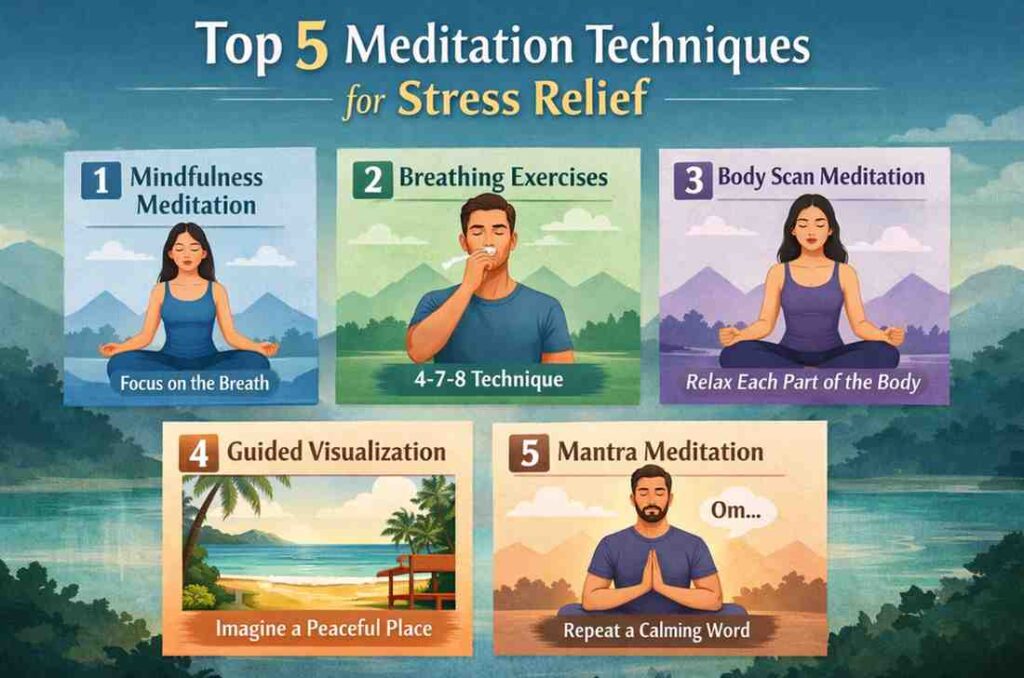
| Mindfulness Meditation | Focus on breathing and stay present. Helps reduce stress and improve focus (5–10 min daily). |
| Breathing Exercises | Use techniques like 4-7-8 to control breath. Calms mind, lowers heart rate, and reduces anxiety. |
| Body Scan Meditation | Focus on each body part and release tension. Helps relaxation and improves sleep quality. |
| Guided Visualization | Imagine peaceful scenes using senses. Promotes deep mental relaxation and stress relief. |
| Mantra Meditation | Repeat a calming word or phrase. Improves concentration and reduces negative thoughts. |
Top 5 Meditation Techniques for Stress Relief
(1). Mindfulness Meditation (Focus on the Breath)
The most studied technique for relieving stress is mindfulness meditation. This technique is as simple as sitting quietly and being aware of the present moment. Simply focus on your breathing. Sit comfortably, close your eyes, and focus on each breath you take. Sit up straight, focus on your breath, and breathe slowly and deeply. If your mind drifts to worries or to-do lists, gently recognize those thoughts as distractions and bring your focus back to your breath.
This simple habit – even 5-10 minutes a day – helps your brain learn to release worry. Science has proven that mindful breathing helps to ease the ‘fight-or-flight’ stress response in your body. As you practice mindfulness more, your brain gets better at noticing stressful thoughts without reacting to them. Experts agree that mindfulness can even decrease your overall stress and anxiety levels, making life more peaceful.
How to perform mindfulness meditation
- Sit comfortably with your back straight. Close your eyes.
- Start by taking a few deep breaths to relax your body, and then let your breathing return to normal.
- Quietly focus on your nose, noticing the air going in and out of your nostrils.
- Notice the coolness of the air while breathing in and the warmth while breathing out. Maintain your focus on this point, and if your mind becomes distracted, try to refocus your mind on your breathing.
(2). Breathing Exercises (4-7-8 and Other Breathwork)
Breath control can be an effective way to calm your mind. When you breathe slowly and deeply, your body receives a message to relax. Your mind becomes calm in an instant. Techniques like 4-7-8 breathing can help calm your mind and give you a sense of control.This technique will eventually slow down your heart rate, lower your blood pressure, and make you feel more at peace.
How to perform Breathing Exercise
- Inhale (4 seconds): Breathe in through your nose slowly.
- Hold (7 seconds): Breathe in deeply and hold your breath for 7 seconds without any strain.
- Exhale (8 seconds): Now, exhale slowly through your mouth, thinking in your mind to count for a few seconds and exhale in a smooth and controlled manner.
Repeat this process 4 to 8 times. Another simple way to calm yourself is to use box breathing (inhale 4, pause 4, exhale 4, ) or deep belly breathing (inhale slowly 3 to 5 seconds, exhale slowly 3 to 5 seconds).
(3). Body Scan Meditation
The body scan is a simple mindfulness practice that helps to reduce stress by focusing your attention on your body. During this practice, your attention is gradually shifted from your head to your toes (or from your toes to your head), focusing on areas of your body that may be experiencing tension, discomfort, or tightness.Once you become aware of these areas, you use your breathing to relax your body and release the tension. This technique helps you become aware of your body while at the same time experiencing a sense of relaxation.
How to do body scan meditation
- Relax your body by sitting in a comfortable position. Close your eyes and breathe in deeply..
- Starting with your feet, focus on all parts of your body in turn (from feet to legs to knees, etc.), moving upwards to your head.
- If you feel any discomfort in any area, try to breathe into that area. While exhaling, say ‘release’ to yourself.
- Take 10-15 seconds to move to all parts of the body.
- At the end, take a full body breath and enjoy the relaxed feeling.
This is a very simple yet very effective technique. It helps you stay in the present moment by giving your mind something to focus on. Your mind is directed to focus on where in your body you are feeling tense and then relax those muscles. A simple practice of a 5-10 minute body scan at the end of a stressful or physically demanding day can really help you relax and improve the quality of your sleep.This practice will, over time, calm your mind by focusing it more on your physical sensations, which will allow you to relax more easily.
(4). Guided Visualization (Guided Imagery)
Guided imagery is like taking your brain on a little break. In this exercise, you think about a peaceful place in your mind, which helps your brain relax. For example, you may think about walking in a forest, seeing the green trees, listening to the sounds of birds, and breathing in the cool air. After this, you may think about arriving at a sunny beach, feeling the sand between your feet, and listening to the sound of the waves. This is a simple exercise to relax your brain.
As you are doing this, you will take slow, deep breaths. As you are thinking of this scene, your body will automatically begin to relax as you take in all the peaceful things you are seeing.You don’t have to make anything happen; you can just let your tension melt away and your thoughts slowly drift away by themselves.
How to Do Guided Visualization
- Sit or lie down in a quiet place. Close your eyes and take deep breaths.
- Think about a place that you feel safe and comfortable in. This could be a beach scene, a forest, a meadow, anything you particularly enjoy. Try to think about this place in as much detail as you can.
- Use your senses to create a mental picture: think about the temperature, any smell (such as pine or salt air), sounds (such as leaves blowing or waves washing), and any wind or sunshine.
- Continue in this peaceful scene for a few minutes. If you find that you’re distracted, gently remind yourself “this is my safe place.”
(5). Mantra Meditation
Mantra meditation is a practice where you focus on a word or sound to maintain concentration. To practice stress relief, you select a soothing word, phrase, or sound and mentally repeat it to yourself. The soothing repetition prevents your mind from being distracted by stressful thoughts.
Examples: The word “Om” is a mantra, but you can use anything you want, like “peace,” “I am calm,” or a short prayer.
How to do Mantra Meditation
- Sit comfortably and close your eyes. Take a few deep breaths.
- Start by repeating the chosen word in your mind at a comfortable speed.
- Allow the sound of the mantra to fill your mind. If you find your mind wandering, go back to the repetition of the mantra.
- Continue for several minutes, or longer if you wish.
A mantra can be a “home base” in the mind, a place you always return to. This can be especially useful when you’re flooded with stressful thoughts. You can use guided mantras or chants, which you can find on a meditation app, but a personal mantra is effective.
Conclusion:
In today’s fast-paced life, stress and anxiety have become a common part of our daily routine. However, we don’t have to let them control our lives. These meditation techniques, ranging from mindfulness and breathing exercises to body scan, guided imagery, and mantra meditation, are simple and effective ways to calm the mind and relax the body. The best part is that they don’t require any special skills or tools, making them easy for anyone to practice anytime.
Frequently Asked Questions
- what are the first signs of stress?
The first signs of stress are too much negative thinking, easily getting angry or irritated, or having trouble concentrating, which can also come with sleep problems, tiredness, or headaches. You may also observe small changes in your appetite or behavior, like avoiding work or overthinking. All these signs are present at the early stages, and they show that stress is developing in you.
- What are the 5 c's of stress management?The 5 C’s of stress management are: control things you can change, stay committed, see challenges positively, believe in yourself, and remain calm.
- How to reduce stress in 5 minutes?
To manage your stress in 5 minutes, sit comfortably and take slow deep breaths by inhaling for 4 seconds and exhaling for 6–8 seconds. In addition, relax your shoulders and focus on your breathing and ignore your thoughts gently.
- Which Mantra Is Best for Reducing Stress?A study published in the Journal of Alternative and Complementary Medicine in 2020 found that mantra meditation, such as Om Namah Shivaya, greatly reduces cortisol levels, which is the stress hormone. You will feel lighter and grounded.
- Which vitamin help reduce stress?The most important vitamins that can help reduce stress are B vitamins, especially Vitamin B12 and Vitamin B6. They can help support brain functions as well as mood regulation.

Health & Wellness Researcher
Nikhil Bhardwaj is a health researcher dedicated to breaking down the latest medical studies into actionable wellness insights. He specializes in the intersection of mental health and physical fitness.
Follow Me