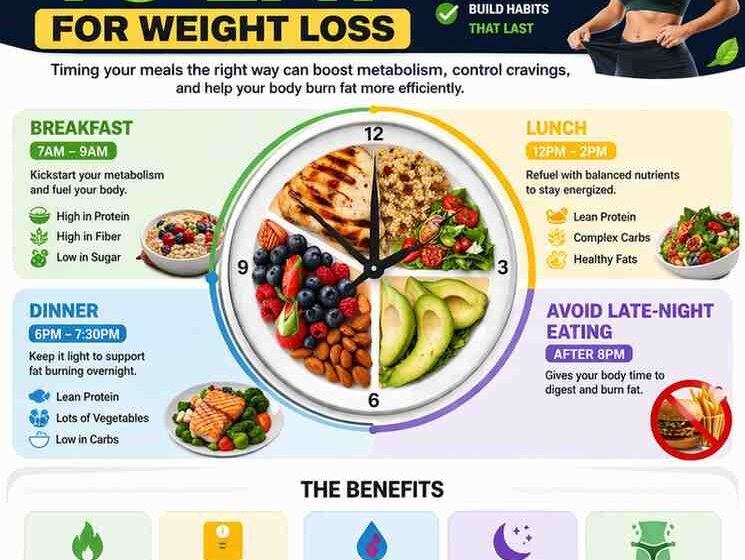
Best Time to Eat Dinner for Weight Loss Nobody Tells You

You work hard on your diet. But your eating time might be quietly working against you — and here’s the simple truth about why.
Okay so real talk — most of us spend so much time worrying about what we eat. Is it too oily? Too many carbs? Should I skip the rice? But almost nobody stops to ask a much simpler question: what time am I eating dinner?
It turns out this question is very important, and the science behind it becomes easy to understand when you look at it in a practical way. One simple habit that can make a real difference is this: try to eat your dinner at least 3 hours before you go to sleep. It sounds small, but it can change how your body handles food, especially at night.
Table of Contents
ToggleBest dinner time for weight loss
Try to finish dinner at least 3 hours before you go to sleep. That’s it. That one change alone can make a real difference.
So if you sleep at 11 PM, try to eat by 8 PM at the latest. If you sleep at 10 PM, aim for 7 PM. Earlier is even better if you can manage it.What really matters is the time gap between your last meal and when you go to bed.
A real study found that people who simply shifted their eating to earlier in the day lost over 5 pounds in 14 weeks — without anyone telling them to eat less. They didn’t count a single calorie. The weight came off just because of the timing.
What happens if you eat late at night?
By evening, your body starts making a hormone called melatonin — the same hormone that makes you feel sleepy. Here’s something really interesting: melatonin actually blocks your body from releasing insulin properly. Insulin is what your body uses to handle sugar from food.
So when you eat a big dinner late at night, your blood sugar shoots up, your insulin can’t do its job properly, and your body ends up storing more of that food as fat. Over time, this makes your body less sensitive to insulin — and that makes losing weight much, much harder.
On top of that, eating late makes your body produce more ghrelin — the hunger hormone. So eating late at night doesn’t just make you store more fat. It also makes you feel hungrier the next day. It’s basically a trap that keeps feeding itself.
A study found that eating after 8 PM specifically hurts your metabolism. And a massive study of over 100,000 people found that those who ate their last meal after 9 PM had a 28% higher risk of heart disease compared to people who ate earlier.
What if you genuinely can’t eat early?
It is not always easy to have dinner at six o’clock if you are working overtime, traveling for long hours, or attending to your family after coming home from work.
Here are some tips that will help if you have no choice but to dine late. For starters, always ensure that your dinnertime remains constant daily. If for example, you eat at 8:30 PM, try to eat at that exact time daily. Your body adjusts to a routine. Irregular timing confuses your internal clock almost as much as eating late does.
Secondly, ensure that the dinner is light during nighttime. There is no need for you to take small meals; all you need to do is ensure that you do not indulge in foods that contain high amounts of carbohydrates and fats in the evening.
Finally, stop all food intake after dinner. Do not eat “a little bit” at 11 PM. The Cleveland Clinic’s research showed that the majority of adults spend around 14 hours of their day consuming food. Simply by narrowing down that time period – without even changing the content of meals – you will effortlessly lower calorie intake.
Is it bad to eat a heavy meal at night?
You’ve probably heard this before: “Eat breakfast like a king, lunch like a prince, and dinner like a pauper.” For years, people thought it was just old folk wisdom. But researchers tested it properly, and it turns out — the old people were right.
In one study, two groups of women ate exactly 1,400 calories per day. Group one had 700 calories at breakfast, 500 at lunch, and just 200 at dinner. Group two did the opposite — small breakfast, big dinner. Same total calories. The group that ate more in the morning lost more weight, had a smaller waist, and felt more full throughout the day.
The majority of people do just the opposite of that. They don’t eat anything for breakfast, eat little during lunchtime, but have an enormous dinner late in the evening at 9 or 10 o’clock.
Does eating late at night cause weight gain?
Eating late at night contributes to gaining weight; however, it is not a question of time but rather the quantity of food consumed during the day. In the case of taking more calories than required by the body, one gains weight, regardless of when they ate their food. On the other hand, eating late in the night causes an increased risk of gaining weight due to poor choices of food such as chips and chocolates. Night time leads to lower activity levels in your body; therefore, the consumption of food takes place while the body burns fewer calories, and the person tends to overeat unknowingly because of engaging in different activities such as watching television or using phones.So, while eating late isn’t the direct cause, it increases the chances of overeating, which can lead to weight gain.
Does intermittent fasting work for weight loss?
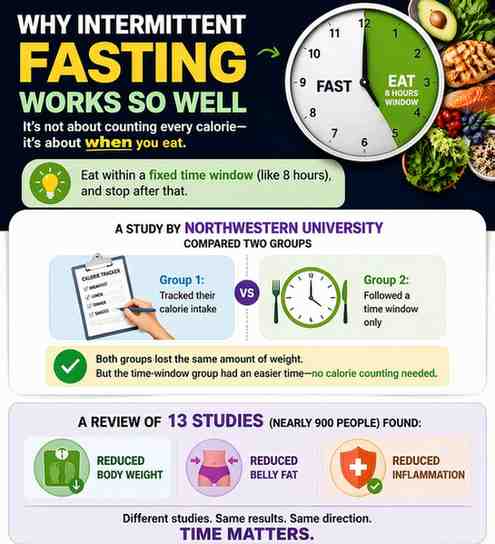
If you’ve ever heard about intermittent fasting, this is one of the main reasons it works for so many people. Instead of tracking every single calorie, you just eat within a fixed time, like 8 hours, and stop after that.
According to a research conducted by Northwestern University, there was a comparison between the two groups; one was assigned to keep track of their calorie intake, and the other one was assigned to follow a time window only. The results showed that both groups lost the same amount of weight. However, the individuals who followed the time window were luckier because they did not need to focus on their calorie intake.
A review of 13 different studies covering nearly 900 people found that eating earlier and finishing earlier reduced body weight, reduced belly fat, and reduced inflammation. That’s a lot of studies all pointing in the same direction.
One last thing — your genes play a small role too
It is very intriguing, and most people do not even discuss such an issue. Research has found that about 44% of individuals possess the gene responsible for sensitivity towards food intake at night time. This means that whenever you feel that you gain weight faster due to late dinners compared to your peers, there might be some scientific logic behind the phenomenon.
But this doesn’t mean you don’t have any options left. This simply means that the timing of your meal is important to you more than it is to other people.If you start paying attention to when you eat, you might see better results than you expect.
Conclusion:
The conclusion is that dieting is not simply a game of calories. It has never been simply a game of calories. Timing of our meals is important – often almost equally important to what we consume.
It has become clear that we need to understand the interaction between our dietary behavior, the timing of meals, and the body’s natural timekeeping mechanism. A healthy lifestyle involves not just counting calories but knowing when to consume them and how.

Health & Wellness Researcher
Nikhil Bhardwaj is a health researcher dedicated to breaking down the latest medical studies into actionable wellness insights. He specializes in the intersection of mental health and physical fitness.
Follow Me