A structured 16-week strength training plan for marathon runners systematically improves running economy, increases joint stability, and builds tendon stiffness to prevent overuse injuries. By pairing progressive overload with your marathon mileage phases, lifting two days per week protects your kinetic chain without compromising endurance performance.
Boosts Efficiency: Helps you burn less energy and run faster with less effort.
Prevents Injuries: Strengthens knees, joints, and ankles to stop common running pains.
Fixes Imbalances: Single-leg lifts keep your hips stable and both legs equally strong.
4-Phase Progress: Moves systematically from basic balance to heavy weights, jump training, and rest.
Just 2 Days/Week: Short sessions twice a week build strength without exhausting your legs.
What Is Strength Training for Marathon Runners?
Strength training for marathon runners is a structured program of resistance exercises—primarily compound movements and unilateral training—designed to improve joint stability, running economy, and injury resistance rather than build maximal muscle size. It targets the same kinetic chain used in running: hips, glutes, calves, and core.
Why Should Marathon Runners Strength Train?
The Full 16-Week Strength Training Plan for Marathon Runners
Phase 1: Base Building & Structural Adaptation (Weeks 1–4)
The focus of Phase 1 is correcting muscular imbalances, mastering movement patterns, and building structural durability in joints and tendons. High-volume, moderate-resistance training prepares your connective tissues for heavier progressive overload in later phases.
Weekly Frequency: 2 sessions per week (30–45 minutes)
Primary Goal: Kinetic chain mobility, glute firing routines, and core stability for marathoners.
Key Exercises for Phase 1
- Bulgarian Split Squats for Pelvic Control
- Reps/Sets: 3 sets × 10–12 reps per side
- Focus: Push through your front heel and keep your hips level to strengthen your glutes and quads and improve pelvic stability.
- Single-Leg Romanian Deadlifts for Hamstrings
- Reps/Sets: 3 sets × 8–10 reps per side
- Focus: Keep your back straight and bend from your hips to strengthen your hamstrings and improve balance and movement control.
- Plank Variations with Hip Extension
- Reps/Sets: 3 sets × 45-second holds
- Focus: Keep your core tight and your hips steady while moving your leg to strengthen your abs and improve core stability.
Phase 2: Maximum Strength & Heavy Resistance (Weeks 5–10)
During peak mileage, runners can do strength training twice a week, ideally on the same days as their hard running workouts. This allows the easier days to stay focused on recovery and helps prevent too much fatigue from building up.
Weekly Frequency: 2 sessions per week (35–50 minutes)
Primary Goal: Maximal strength development using heavy compound movements.
| Exercise | Target Muscles | Sets × Reps | Rest |
|---|---|---|---|
| Barbell Back Squats | Quadriceps, Glutes, Lower Back | 4 × 5 | 2–3 mins |
| Weighted Calf Raises (Seated/Standing) | Gastrocnemius, Soleus | 4 × 8–10 | 90 secs |
| Overhead Dumbbell Press | Deltoids, Upper Trapezius, Core | 3 × 8 | 90 secs |
| Single-Leg Step-Ups | Gluteus Maximus, Hamstrings | 3 × 6 per leg | 90 secs |
Phase 3: Power & Plyometric Training (Weeks 11–14)
Plyometric training includes explosive movements such as jumps, hops, and bounds. These exercises help runners develop reactive strength and power while also training the muscles and tendons to handle force quickly.
Tendons can store and release elastic energy like a spring during running, helping your lower legs respond efficiently with each foot strike. Over time, this can support better running economy, stability, and overall movement efficiency.
Weekly Frequency: 2 sessions per week (30–40 minutes)
Primary Goal: Rate of force development, explosive power, and quick ground contact time.
Key Plyometric Exercises
- Plyometrics and Pogo Jumps for Explosive Power: 3 sets × 20 jumps
Focus: Jump quickly with short ground contact time while keeping your ankles firm. - Single-Leg Bound Latches: 3 sets × 6 bounds per leg
Focus: Land with control and keep your knee and ankle stable while building explosive hip power. - Eccentric Calf Drops: 3 sets × 10 reps per leg
Focus: Lower your heel slowly and under control to build calf strength and improve Achilles tendon control.
Phase 4: Taper & Race Week (Weeks 15–16)
During the marathon taper, reduce your strength training by 60–70% while keeping the intensity moderate. This helps maintain muscle strength and coordination without causing too much soreness or fatigue.
Week 15 & 16 Schedule
- Week 15 (7 Days Out): Do 1 light strength session with bodyweight single-leg exercises, easy glute exercises, and mobility work.
- Week 16 (Race Week): Avoid heavy lifting. Do light bodyweight exercises and mobility drills only, and stop strength training at least 4 days before race day.
Essential Exercises for Marathon Runners
1. Bulgarian Split Squats for Pelvic Control
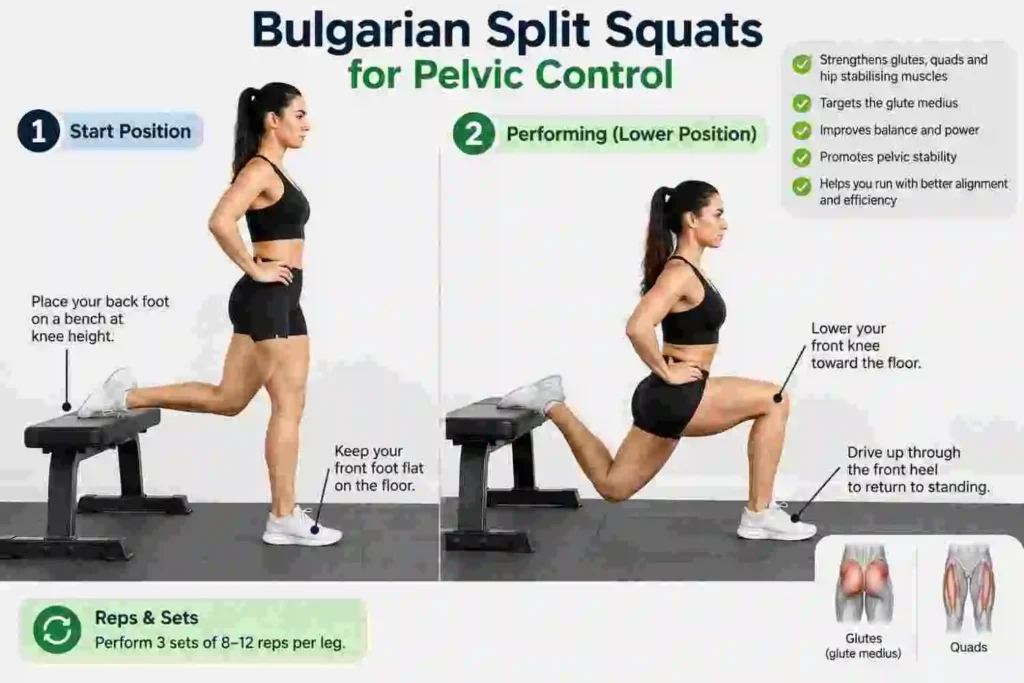
Bulgarian split squats strengthen the glutes, quads, and stabilising muscles in the hips while improving power and balance. This exercise specifically targets the glute medius, which keeps hips stable during the run. By promoting pelvic stability, you sidestep injury and run with more efficiency through better body alignment at the hips and knees.
How to perform: Place your back foot on a bench at knee height. Lower your front knee toward the floor, then drive up through the front heel. Perform 3 sets of 8–12 reps per leg.
2. Single-Leg Romanian Deadlifts for Hamstrings
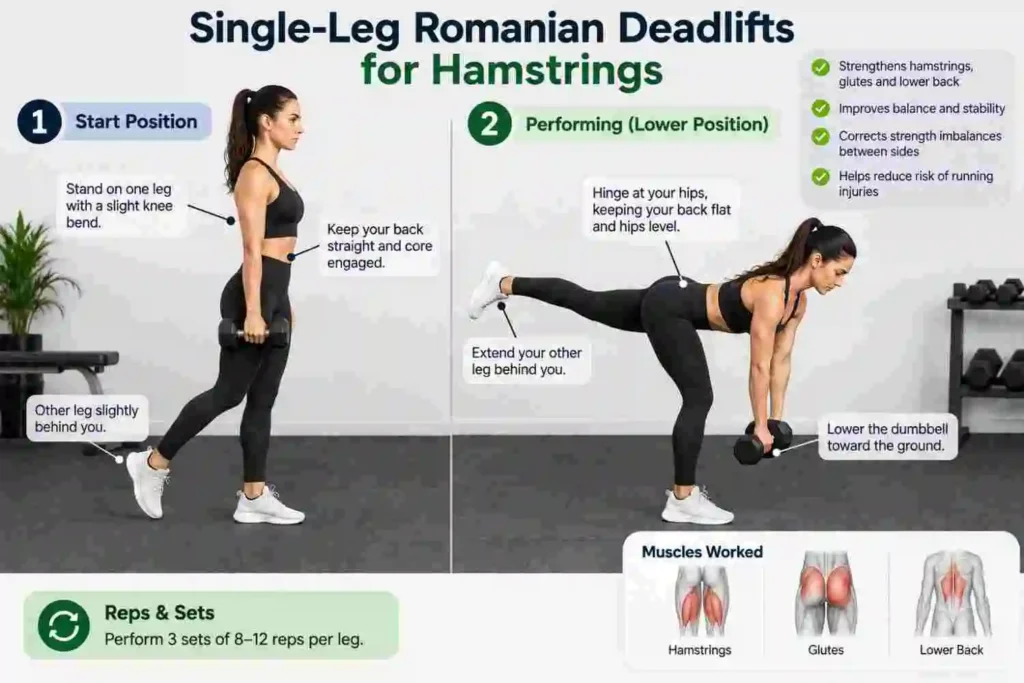
This exercise builds strength through the hamstrings, glutes, and lower back while challenging your balance. It corrects strength imbalances between left and right sides—a common contributor to running injuries.
A cohort study of 77 high school track athletes found that incorporating the single-leg Romanian deadlift into warm-ups reduced the risk of mild to moderate hamstring strain injuries (RR = 0.34).
How to Perform: Stand on one leg and slowly hinge at your hips while keeping your back flat and hips level. Lower the dumbbell toward the ground as you extend your other leg behind you. Return to the starting position and repeat for 3 sets of 8–12 reps per leg.
3. Plyometrics and Pogo Jumps for Explosive Power
Plyometric exercises can improve running economy by helping your tendons store and release elastic energy more efficiently. Pogo jumps involve quick, repeated bounces using your ankles and calves. They train the stretch-shortening cycle and help you spend less time on the ground with each jump.
How to perform: Jump straight up using your ankles and calves while keeping your knees slightly bent. Land softly and bounce back up quickly. Perform 3 sets of 20 reps.
Why Is Unilateral Training Non-Negotiable for Runners?
Unilateral training is important for runners because running is a single-leg activity. Each step requires one leg to support your body, control your landing, and produce force on its own. Exercises such as Bulgarian split squats and single-leg Romanian deadlifts help build single-leg strength, balance, hip stability, and coordination.
Training one leg at a time can also reveal left-to-right strength differences, hip drop, knee instability, or poor ankle control that bilateral exercises may hide. Adding unilateral exercises to your strength routine helps improve movement control and prepares each leg for the demands of running.
How Do Plyometrics Build Reactive Strength?
Plyometric exercises and pogo jumps help develop reactive strength, explosive power, and tendon stiffness. They train your muscles and tendons to quickly absorb and release force, helping you rebound from the ground more efficiently. Exercises such as pogo jumps and bounding can be performed for 2–3 sets after your warm-up and before strength training.
Eccentric training, such as slow-lowering Romanian deadlifts, builds the strength and control needed to slow your body down, especially when running downhill. Plyometrics train your legs to act like springs, while eccentric exercises train them to act like brakes. Both are useful for handling different types of terrain during a marathon.
How Does Strength Training Improve Running Economy?
Running economy improvement comes from stiffer tendons, stronger hip extensors, and reduced ground contact time. When you perform compound movements and plyometric exercises, your muscles and connective tissues store and return more elastic energy with each stride. This means you use less oxygen to maintain the same pace.
Does Strength Training Prevent Overuse Injuries in Marathon Training?
Strength training can help reduce the risk of overuse injuries by strengthening muscles, tendons, and other connective tissues. It also improves soleus strength and helps your lower legs handle the demands of high-mileage running.
Targeted exercises can address muscle imbalances and support the entire kinetic chain, which may help reduce the risk of common running problems such as patellofemoral pain, Achilles tendinopathy, and plantar fasciitis.
Key Injury Prevention Benefits:
- Glute activation: Strengthens the glutes, improves hip power, and helps keep the knees in a stable position.
- Core stability: Helps keep your hips and pelvis steady, especially when you get tired.
- Eccentric training: Slow lowering movements improve control when slowing down or landing.
- Unilateral training: Single-leg exercises help improve balance and address strength differences between sides.
- Soleus strength: Calf raises strengthen the soleus and help the lower leg handle running load, supporting Achilles tendon health.
How Does Core and Upper Body Strength Affect Marathon Performance?
Core and upper-body strength help runners maintain good posture, stability, and efficient movement throughout a marathon. A strong core keeps the pelvis and torso stable, while upper-body strength helps maintain controlled arm movement and posture as fatigue builds.
This can help reduce unnecessary movement and energy loss, allowing you to maintain your running form for longer. Exercises such as planks, rows, overhead presses, and controlled core movements can support running economy, posture, stability, and endurance during long-distance running.
Common Marathon Strength Training Mistakes
- Skipping the base-building phase and jumping straight to plyometrics
- Lifting to failure during peak mileage weeks, spiking DOMS
- Ignoring unilateral work in favor of only bilateral, gym-standard lifts
- Adding new exercises during taper, when the body should only reinforce familiar movement patterns
Conclusion
Executing a structured 16-week strength training plan for marathon runners is the single most effective strategy to optimize running economy, safeguard the kinetic chain, and eliminate overuse injuries. By aligning targeted resistance exercises with your endurance periodization, you build the resilient tendon stiffness and pelvic control needed to maintain form late into 26.2 miles.
Frequently Asked Questions
- Compare strength plans for marathoners: 16-week vs 12-week?A 16-week plan gives beginners more time to build strength and adapt before heavy training, while a 12-week plan works better for runners who already have a solid strength base.
- What are the best 16-week strength plans for marathon training?A beginner marathon runner should start with bodyweight and light-resistance exercises like squats, glute bridges, and calf raises to build strength, movement control, and tissue durability.
- How can I avoid injuries while strength training for a marathon?To avoid injuries while strength training for a marathon, use proper form, start with manageable weights, and increase the load gradually.
- What does a typical marathon strength routine focus on?A typical marathon strength routine focuses on building single-leg stability, strengthening the posterior chain, and improving tendon stiffness rather than adding muscle size.
- Which strength plan suits a beginner marathon runner?A 16-week strength plan is generally safer for most runners because it gives your muscles, joints, and tendons more time to adapt before heavier training.
- How do I balance strength and running without overtraining?Balance strength and running by doing 2 strength sessions per week, preferably on hard running days. Keep easy days for recovery and reduce strength volume as your marathon mileage increases.
- What Is the Best Strength Training Plan for a Marathon Runner With Limited Time?The best time-efficient strength plan for a marathon runner is 2 short sessions per week, focusing on squats, single-leg exercises, calf raises, core exercises, and upper-body strength.
Read Our Related Guides
- Beginner’s Guide to Strength Training for Runners: Exercises, Tips & Weekly Plan – Learn the basics of strength training for runners, including beginner-friendly exercises, practical tips, and a weekly plan.
- Strength Training Plan for Runners: Exercises, Sets & Reps – Follow a structured strength plan with recommended exercises, sets, and repetitions for runners.
- Strength Training for Endurance Athletes: Beginner to Advanced Guide for Runners, Cyclists & Triathletes – Explore strength training strategies for endurance athletes, from beginner fundamentals to advanced training.
Author: Nikhil Kumar
Nutrition & Fitness Writer | Health Enthusiast
Nikhil Kumar writes about nutrition, fitness, and healthy living, with a focus on turning evidence-based health information into simple, practical, and easy-to-understand advice. He has completed a nutrition certification through Coursera and stays updated with the latest research in nutrition, exercise, fitness management, and healthy lifestyle practices.
Through his work, Nikhil aims to provide reliable, science-backed information that helps readers make informed health and fitness decisions while developing healthy, sustainable habits.
Pingback: Strength Training Plan for Runners: Exercises & Weekly Schedule