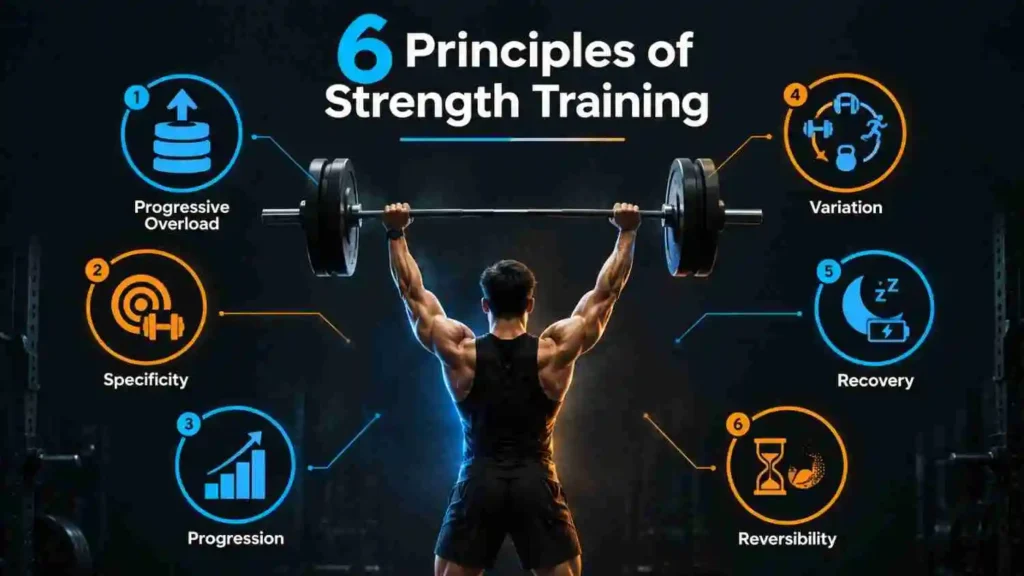
The principles of strength training are six fundamental principles: progressive overload, specificity, progression, variation, and recovery. Resistance training builds strength when you gradually increase the demand on your muscles, train the movements you want to improve, and rest enough to adapt. Follow these core principles and you gain lean muscle mass, lower injury risk, and keep improving for years.
- Progressive overload: Gradually increase weight, reps, or sets so muscles keep adapting.
- Specificity: Train the exercises and rep ranges that match your goal.
- Progression: Raise the load at a pace your body can recover from.
- Variation: Change exercises, reps, or training phases to prevent plateaus.
- Recovery: Sleep, eat enough protein, and rest so muscles can repair and grow.
- Reversibility: Strength and muscle fade when training stops, so stay consistent.
What Are the Principles of Strength Training?
The principles of strength training are the scientific rules that explain how the body gets stronger. They come from exercise physiology, the study of how the body responds to physical stress. Every good program, from a beginner plan to an elite periodization model, rests on them.
Think of them as the training foundations. Exercises are the tools. Principles are the instructions for using the tools.
1. Progressive Overload
Progressive overload means gradually increasing the stress placed on your muscles. Your body can only adapt to the demands placed upon it. Therefore, if you want to see results, you must gradually increase the intensity of your workouts.
You can overload in several ways:
- Add weight to the bar.
- Add reps or sets.
- Slow the tempo to raise time under tension.
- Shorten rest intervals.
- Improve form and technique so each rep is harder to cheat.
A simple rule works well. When you complete every set at the top of your rep range, add 2% to 5% load next session.
2. Specificity of Training
The specificity of training is a concept that implies that a person improves in those areas that are subject to training. Thus, squats will make you squat better, and pull-ups will help you do pull-ups. Exercises with a heavy load improve strength, and sets of several repetitions increase muscle mass.
Match your training to your goal:
- Maximal strength: heavy loads, low reps, long rests.
- Hypertrophy training: moderate loads, moderate reps, short to medium rests.
- Muscular endurance: lighter loads, high reps, short rests.
3. Progression
Progression is the planned rate of overload increase matching your recovery speed (e.g., session-by-session for beginners, weekly for intermediates).
Beginners can often progress every session. Intermediates – every week. Advanced lifters – every few months. And it’s all about managing the load to match the pace of progression.
4. Variation and Periodization
Periodization is the systematic planning of training phases (volume, intensity, recovery) to prevent plateaus and manage fatigue.
A basic structure looks like this:
- Hypertrophy phase (4 to 6 weeks): moderate loads, higher training volume.
- Strength phase (4 to 6 weeks): heavier loads, lower reps.
- Peak or test phase (1 to 2 weeks): test your max or a rep goal.
- Deloading week: cut volume by about 40% to 50%.
5. Recovery
Recovery requires 7-9 hours of sleep, ~1.6g/kg daily protein, and 48 hours of rest per muscle group between heavy sessions.
Prioritize these:
- Sleep: aim for 7 to 9 hours.
Protein: about 1.6 g per kg bodyweight daily.
Calories: enough to support training (you can calculate your target intake based on your weight and activity level).
- Rest days: at least 48 hours before hitting the same muscle hard again.
Good fatigue management also involves paying attention to soreness, mood, and performance. If all three are low for a given week, it’s time to deload
6. Reversibility
Reversibility means that you will lose fitness when you stop training. The body only keeps adaptations it continues to use which is also called detraining.
What Happens When Training Stops
- Weeks 1-3: Strength is maintained moderately well. The adaptation of the nervous system that you have achieved will last for some time.
- After 3-4 weeks: Strength and work capacity begin to decrease. Your conditioning and endurance will decline more rapidly than your strength.
- After 1-3 months: Your lean muscle mass will begin to decrease. This will cause a loss of strength.
- After a prolonged break: You will be able to maintain a significant percentage of your gains, but not all of them.
How to Prevent Detraining
- Apply high intensity and low volume. When lifting heavier weights, the risk of diminishing gains is minimal even when reducing the number of sets.
- Work each muscle at least once a week during the busy season.
- Use a short maintenance workout. It is possible to use two or three compound exercises for 20-30 minutes instead of the usual ones.
- Finally, stay active throughout the year.
- During the travel period or when injured, it is possible to use bodyweight exercises or work out the muscles that are not affected.
- In addition, plan a deloading period. One week of reduced training is not a waste of time as it allows the body to adapt.
How Strength Gains Actually Happen
Nervous System Adaptation
During the first 4-8 weeks, the majority of your gains will come from your nervous system adaptation. This means that you’re essentially teaching your brain to utilize a higher percentage of muscle fibers and making those fibers contract with greater synchronization.
Muscle Growth
Hypertrophy is the point at which progression becomes visible. Mechanical tension, muscle damage, and metabolic stress trigger the anabolic process that builds lean muscle mass. Increased volume combined with adequate protein intake spurs hypertrophy.
The Kinetic Chain
Kinetic Chain refers to the anatomical connections between joints and muscles. They work as a system, and a single weak point can make the whole chain malfunction. That’s why mobility and joint training are so important. They should be part of any structured program.
Training Variables for Strength and Conditioning
Every workout is built from five levers. Learn them and you can fix almost any stalled program.
Training Volume
Training volume is total work done. Use this formula:
Volume load = sets × reps × weight
Example: 4 sets × 8 reps × 60 kg = 1,920 kg.
This means you lifted a total volume of 1,920 kg across all 4 sets, not that you lifted 1,920 kg at once.
Training Intensity
1RM = weight × (1 + reps ÷ 30)
Example: 80 kg × 5 reps = 80 × (1 + 5 ÷ 30) = 80 × 1.167 = 93.3 kg.
Training Frequency
Training frequency is how often you train a muscle. Two to three times per week works for most people. Higher frequency spreads volume across the week and improves practice of each lift.
Reps and Sets
Reps and sets shape the result. Here is a target-based conversion for a lifter with a 100 kg 1RM:
| Goal Reps | Working Weight | Calculation |
|---|---|---|
| 5 reps | about 86 kg | 100 ÷ (1 + 5/30) |
| 8 reps | about 79 kg | 100 ÷ (1 + 8/30) |
| 10 reps | about 75 kg | 100 ÷ (1 + 10/30) |
| 12 reps | about 71 kg | 100 ÷ (1 + 12/30) |
These are estimates. Actual loads vary by exercise and by person.
Rest Intervals
- Heavy compound lifts: 2 to 3 minutes
- Hypertrophy work: 60 to 90 seconds
- Accessory exercises: 45 to 60 seconds
Exercise Selection for Strength Training
Compound Exercises
Compound exercises train multiple joints. Squats, deadlifts, presses, and rows build strength fastest – do one or two of these big moves every session.
Assistance Exercises
Assistance exercises are movements that focus on weaker areas and increase volume. Such exercises include curls, lateral raises, and hamstring curls. They help to build the muscles being worked on and prevent injuries.
Unilateral Training
Unilateral training involves working one side of the body at a time. This can include split squats and single-arm rows. It helps to balance out the left and right sides and also works the core and improves balance.
Comparison: Ways to Train Strength
| Method | Main Benefits | Tradeoffs | What You Need |
|---|---|---|---|
| Bodyweight Strength | Free, portable, joint-friendly, improves body control | Hard to increase resistance over time | Basic mobility and enough space |
| Weight Training | Easy progressive overload, many exercise options, builds strength | Needs equipment and proper technique | Weights, basic equipment, and training knowledge |
| Barbell Training | Allows heavy weights and builds maximum strength | Needs good technique and careful weight control | Good lifting form, barbell rack, and safety equipment |
| Machine-Based Resistance Training | Stable, beginner-friendly, easy to control, supports muscle isolation | Provides less stabilizer muscle work | Gym access and basic machine knowledge |
Common Mistakes and Misconceptions
- Lifting heavy every session. Without variation and deloading, fatigue piles up.
- Chasing soreness. Soreness does not measure progress. Logbook numbers do.
- Ignoring form and technique. Ego lifting is the fastest route to injury.
- Skipping warm-ups and mobility. Poor joint health limits long-term progress.
- Changing programs every two weeks. Progress needs consistency.
- Believing women get bulky or older adults should avoid lifting. Both are false. Strength training benefits every age group.
- Forgetting reversibility. Strength fades if you stop. Even a short maintenance routine protects gains.
Advanced Training Methods
- Autoregulation: Adjust the weight based on how you feel that day. Use reps in reserve (RIR) or perceived effort to control training intensity.
- Tempo Training: Lower the weight slowly for 3–4 seconds to increase time under tension and make the muscles work longer.
- Block Periodization: Divide training into different phases, such as volume, strength, and peaking, with each phase having a specific goal.
- Wave Loading: Switch between heavy and moderate training weeks to build strength while managing fatigue.
- Specialization Blocks: Increase training volume for lagging muscles while keeping other muscle groups at maintenance volume.
Future Trends in Strength Training
- Velocity-Based Training: The Use of Sensors to Measure Bar Speed Determine Loads and Assess Fatigue
- The Importance of Recovery Data From Wearable Suits to Measure Heart Rate Variability and Sleep
- Programming Based on Performance Data From Apps That Automate Volume in Response to Performance
- More Programs Aim to Promote Longevity by Improving Muscle, Bone Density, and Joint Health
Strength Training vs. Conditioning
Strength training develops the ability to produce force, using heavy loads and low to moderate reps. Conditioning develops work capacity, which is the ability to perform work for an extended period of time, using energy-system work like intervals, circuits, and steady cardio. Strength conditioning trains both so that you can perform heavy lifts with good recovery.
Next Steps: Your Practical Framework
- Pick one clear goal: strength, size, or general fitness.
- Schedule 2 to 3 full-body or 3 to 4 split sessions per week.
- Build each session around 2 to 3 compound exercises.
- Add 1 to 2 assistance exercises for weak points.
- Choose a rep range that matches your goal.
- Log every set: weight, reps, effort.
- Apply progressive overload once you hit the top of your rep range.
- Rest 2 to 3 minutes on heavy lifts.
- Do 5 to 10 minutes of mobility training before lifting.
- Eat about 1.6 g protein per kg bodyweight daily and sleep 7 to 9 hours.
- Deload every 4 to 8 weeks, or sooner if performance drops.
- Review progress every 4 weeks and adjust one variable at a time.
Conclusion
The principles of strength training are simple: lift a little more over time with progressive overload, train the movements you want to improve, and change your plan before it goes stale. Rest well so your body can adapt, and deload every 4 to 8 weeks. Stick to these core principles in your resistance training, and the strength will follow.
Frequently Aseked Questions
- What are the 6 principles of strength training?The six principles of strength training are progressive overload, specificity, progression, variation, recovery, and reversibility.
- What is the principle of reversibility in strength training?Reversibility means that a person loses their gains in strength and muscle mass when they stop working out. One’s strength tends to remain steady for the first three to four weeks after a workout.
- What is specificity of training?Specificity means your body adapts to the exact type of training you do. If you squat, you get better at squatting.
- How often should I do strength training per week?Most adults should train each major muscle group 2 or 3 times a week.
- What is a deload, and when do I need one?A deload is a planned easier week where you cut training volume by about 40% to 50%.
- Can I build strength with bodyweight exercises only?Yes. Bodyweight strength training builds real strength, especially for beginners.
Disclaimer: This content is for educational purposes and is not medical advice. Consult a qualified healthcare professional before starting a new exercise program, especially if you have an injury or medical condition.
Author: Nikhil Kumar
Nutrition & Fitness Writer | Health Enthusiast
Nikhil Kumar is a Nutrition & Fitness Writer passionate about making evidence-based wellness simple and actionable. After completing a nutrition certification via Coursera, he continuously follows the latest research on food, movement, and longevity. His mission is to provide trustworthy, practical guidance that helps readers achieve their health goals confidently.