Key points
- Fixes muscle imbalances — Cycling overworks quads and hip flexors, leaving glutes, core, and upper body weak.
- Minimal equipment needed — Bands, dumbbells, a mat, and a chair are enough.
- Twice a week is best — With a 48-hour gap before hard rides.
- Results follow a timeline — Gains by 6–8 weeks, full benefits by 3–4 months.
- No heavy weights needed — Progress with more reps, slower tempo, or single-leg moves.
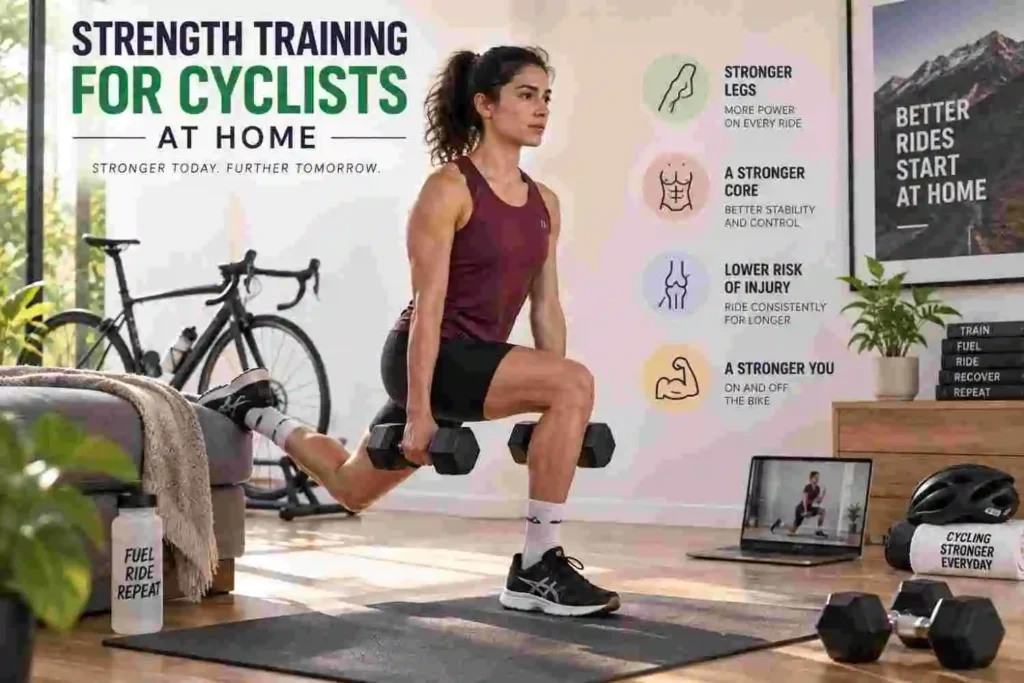
Why Cycling Strength Training at Home Actually Works
Pedaling is a repetitive, single-plane motion. It trains your quads and hip flexors through a narrow range of motion, thousands of times per ride, but it barely touches your posterior chain, core, or upper body.
That imbalance creates predictable problems:
- Weak glutes shift load onto the knees, a common driver of patellofemoral pain in cyclists.
- Underdeveloped core strength leaks power every pedal stroke, since a stable trunk is what lets your legs transfer force efficiently.
- Neglected upper body strength shows up as fatigue and poor bike handling in the final hour of long rides.
Cycling strength training at home closes these gaps directly. You don’t need a squat rack—you need a program that hits the muscles your bike ignores.
The Physiology Behind Strength Gains for Cyclists
Strength adaptations happen through two overlapping systems, and understanding both explains why a home program can rival a gym-based one.
Neuromuscular adaptation happens first. During the first 2–4 weeks, your nervous system learns to recruit more motor units and make your muscle fibers work together more efficiently. This is why beginners can become stronger quickly, even before they see noticeable muscle growth.
Progressive overload—slowly increasing reps, resistance, or exercise difficulty—helps drive this adaptation. Bodyweight and resistance-band exercises can provide effective overload when you adjust these variables properly.
After the first month, hypertrophy and connective tissue strengthening become more important with consistent training. Muscles can adapt faster than tendons and ligaments, so it is better to increase training volume gradually instead of suddenly using heavy or high-intensity loads. This gradual approach also supports injury prevention.
Stronger tendons and better joint stability around the knees and hips can help reduce the risk of overuse injuries, which are common among cyclists who train frequently.
The American College of Sports Medicine (ACSM) guidelines for general strength development recommend training each major muscle group 2–3 times per week with at least one rest day between sessions targeting the same muscles. For cyclists layering strength work onto an existing ride schedule, twice weekly is the realistic, sustainable target.
Multi-Planar Training for Cyclists
Cycling mainly uses the sagittal plane, which means moving straight forward and backward. However, good off-bike performance also requires control in multiple directions. Training the frontal plane and transverse plane helps improve pelvic stability, reduce hip sway, and support better power transfer when cycling out of the saddle.
- Frontal Plane Stability (Adductors & Glute Medius): Exercises such as Cossack squats and lateral lunges strengthen the inner thighs, adductors, and hip abductors. This helps prevent knee valgus, or the knee collapsing inward, and supports smooth knee and leg movement throughout the 360-degree pedal stroke.
- Transverse Plane Control (Core Anti-Rotation): Band-resisted rotational chops help develop anti-rotational core strength. This allows cyclists to better control unwanted rotation and resist handlebar pull during sprinting and steep, low-cadence climbs.
- Eccentric Control for Vibration Absorption: Downhill mountain biking and rough gravel trails create repeated impacts and vibrations through the legs. Eccentric tempo training, such as using a 3-second lowering phase during split squats, teaches the muscles to absorb shock, control movement, and reduce fatigue.
Cadence & Power Metric Alignment
Strength training can improve pedal stroke power by increasing maximal neuromuscular force and the Rate of Force Development (RFD). This helps cyclists produce force more effectively at different cadences and riding intensities.
- Low-Cadence Grinding (Torque): Heavy resistance training helps recruit high-threshold Type II muscle fibers. This can increase the maximum torque you can apply to the pedals when riding on steep gradients.
- High-Cadence Bursts (Sprinting): Strong fast-twitch glute activation helps cyclists produce force quickly through the 12 o’clock dead-spot phase of the pedal stroke. This can make cadence transitions smoother during sprinting.
- Fuel Efficiency: Stronger muscles can produce the same wattage output with less overall muscular effort. This may help conserve glycogen stores, improve metabolic efficiency, and support endurance during long-distance cycling.
Building Your Home Gym Setup for Cycling Strength Training
You don’t need a full home gym to build strength for cycling. A few simple pieces of equipment can make your workouts more effective and versatile:
Resistance bands (light, medium, and heavy) — inexpensive, portable, and useful for glute activation, strength exercises, and mobility work.
Adjustable dumbbells — allow you to increase resistance gradually and perform exercises such as split squats, rows, and weighted lunges.
Yoga mat — provides a comfortable, stable surface for core exercises, isometric holds, and stretching.
Sturdy chair or step — works well for step-ups, elevated lunges, and other single-leg exercises.
Best Strength Exercises for Cyclists at Home
Execute this full-body routine 2 times per week during the off-season or base phase, keeping a 48-hour gap between heavy strength work and high-intensity interval training (HIIT) bike sessions.
Workout A: Lower Body Power and Stability
1. Goblet Squat — 3 × 8–10
Hold one dumbbell vertically at chest height. Sit down between your hips, not back. Drive through your whole foot. This is your primary quad and glute builder.
2. Romanian Deadlift — 3 × 8–10
Hold dumbbells at your sides with a slight knee bend. Hinge at the hips until you feel your hamstrings stretch. Squeeze your glutes to stand. Do not round your lower back.
3. Bulgarian Split Squat — 3 × 8 per leg
Rear foot on a chair. Front foot far enough forward that your knee stays over your ankle. Lower until your back knee nearly touches the floor. This is the single most effective exercise for fixing left-right power imbalances.
4. Single-Leg Glute Bridge — 3 × 10 per leg
Lie on your back, one foot planted, the other leg extended. Drive your hips up by squeezing the glute of the planted leg. Hold for one second at the top.
5. Dead Bug — 3 × 10 per side
Lie on your back with arms extended and knees at 90 degrees. Lower your right arm and left leg toward the floor while keeping your lower back pressed down. This builds the anti-extension core strength that protects your spine on long rides.
6. Standing Calf Raise — 3 × 15
Rise onto the balls of your feet, pause, and lower slowly. Add a dumbbell in one hand for load.
Workout B: Core Strength and Upper Body Endurance
1. Single-Arm Dumbbell Row — 3 × 10 per side
Brace one hand on a chair. Pull the dumbbell to your hip, squeezing your shoulder blade toward your spine. This counteracts the forward-hunched cycling posture.
2. Floor Press or Band Chest Press — 3 × 10
Lie on your back with dumbbells at chest level. Press up until your arms are straight. Keep your elbows at roughly 45 degrees from your torso.
3. Band Pull-Apart — 3 × 15
Hold a light band at shoulder height with straight arms. Pull it apart until your arms are wide. Squeeze your upper back at the end range. This directly strengthens the postural muscles that cycling weakens.
4. Hip Thrust (Weighted) — 3 × 10
Sit with your upper back against a couch, feet planted. Place a dumbbell across your hips. Drive up until your torso is parallel to the floor. Squeeze hard at the top.
5. Pallof Press (Anti-Rotation) — 3 × 10 per side
Anchor a band at chest height. Stand sideways to the anchor, hold the band at your sternum, and press it straight out. Resist the rotation. This builds the oblique and deep core strength that stabilises your pelvis during hard efforts.
6. Plank — 3 × 30–45 seconds
Standard forearm plank. Squeeze your glutes, brace your abs, and breathe.
Progressive Overload Without Weights
Since you may not have heavy weights at home, you can progress your workouts by adjusting other variables:
- Increase reps before adding resistance.
- Slow the tempo—a 4-second lowering phase on a squat adds significant time under tension.
- Add unilateral versions—a single-leg squat is dramatically harder than a two-legged one.
- Reduce rest periods between sets to build muscular endurance alongside strength.
Sample Weekly Training Schedule
| Day | Focus |
|---|---|
| Monday | Workout A — Lower Body |
| Tuesday | Easy Ride or Rest |
| Wednesday | Workout B — Core & Upper Body |
| Thursday | Intervals or Endurance Ride |
| Friday | Active Recovery — Mobility & Foam Rolling |
| Saturday | Long Ride |
| Sunday | Rest |
Scheduling Strength Around Your Cycling
Off-Season
Perform three sessions per week with higher volume. Training on the bike is reduced, so more soreness is tolerable.
Pre-Season
Reduce to two sessions per week. Shift toward higher intensity and lower volume. Introduce explosive movements like jump squats or kettlebell swings.
In-Season
Train with the minimum effective dose: one or two sessions per week using moderate loads. The goal in-season is to maintain strength without creating fatigue.
Never schedule loaded resistance training the day before a hard bike session. Give yourself at least 48 hours between a heavy leg day and a threshold or VO2max workout.
Safety, Modifications, and Realistic Timelines
Beginners should start with two sets per exercise instead of three and prioritize form over range of motion, especially on single-leg movements where balance is still developing.
Riders with existing knee pain should modify squats and lunges to a shallower depth and emphasize glute bridges, which load the hips more than the knees.
Expect noticeable improvements in cycling performance within 6–8 weeks of consistent training—this aligns with typical neuromuscular and early hypertrophy timelines documented in sports science literature.
Full connective tissue adaptation, the kind that meaningfully reduces overuse injury risk, takes closer to 3–4 months.
A few non-negotiables:
- Warm up with 5 minutes of dynamic stretching before every session—never stretch cold muscles statically.
- Schedule rest days between sessions hitting the same muscle groups to avoid overtraining syndrome.
- Stop any exercise that causes sharp or joint-specific pain, as distinct from normal muscular fatigue.
- Fuel and hydrate around sessions; strength training adds to your total training load, and recovery nutrition matters as much as it does after a ride.
Conclusion
Strength training for cyclists at home doesn’t require a gym membership or heavy equipment — just consistency and the right exercises. A few dumbbells, resistance bands, and two focused sessions a week are enough to fix muscle imbalances, boost power output, and protect your knees and joints from overuse injuries.
Frequently Asked Questions
- How can cyclists build leg strength without gym access?Cyclists can build leg strength at home with bodyweight exercises such as squats, lunges, step-ups, and single-leg exercises.
- What are the best home strength workouts for cyclists with limited time?A short full-body workout combining squats, lunges, hip-hinge exercises, calf raises, and core exercises is effective for cyclists with limited time.
- How can cyclists compare bodyweight and resistance band training?Bodyweight training uses your own body mass as resistance, while resistance bands allow you to adjust the level of external resistance more easily.
- How can cyclists balance cycling and strength training?Cyclists can balance both by scheduling strength sessions around their key rides and allowing enough recovery between demanding workouts.
- How can cyclists set up a home gym for strength training?Cyclists can set up an effective home gym with basic equipment such as resistance bands, dumbbells or kettlebells, and a stable bench or step.
Source&References
Author: Nikhil Kumar
Nutrition & Fitness Writer | Health Enthusiast
Nikhil Kumar is a nutrition and fitness writer who turns evidence-based health and wellness information into clear, practical, and easy-to-follow guidance. He has earned a nutrition certification through Coursera and stays up to date with research in nutrition, exercise, fitness, and healthy lifestyle practices.