A 12-week strength training program for cyclists works in three connected phases: four weeks of anatomical adaptation, four weeks of maximum strength, and four weeks of power conversion, trained twice a week alongside your normal riding. Done right, it adds real watts to your pedal stroke, protects your knees and lower back over long rides, and doesn’t pack on bulk that slows you down.
| Point | Details |
|---|---|
| Program length | 12 weeks, divided into three 4-week phases |
| Frequency | 2 strength sessions per week during the off-season, reducing to 1 session per week once racing begins |
| Core movements | Squats, deadlifts, split squats, single-leg presses, and anti-rotation core exercises |
| Why it works | Heavy strength training can improve cycling efficiency and anaerobic power, mainly through neuromuscular adaptations rather than increases in VO₂ max |
| Best time to start | Start during the off-season or base-training period so strength adaptations can develop before racing begins |
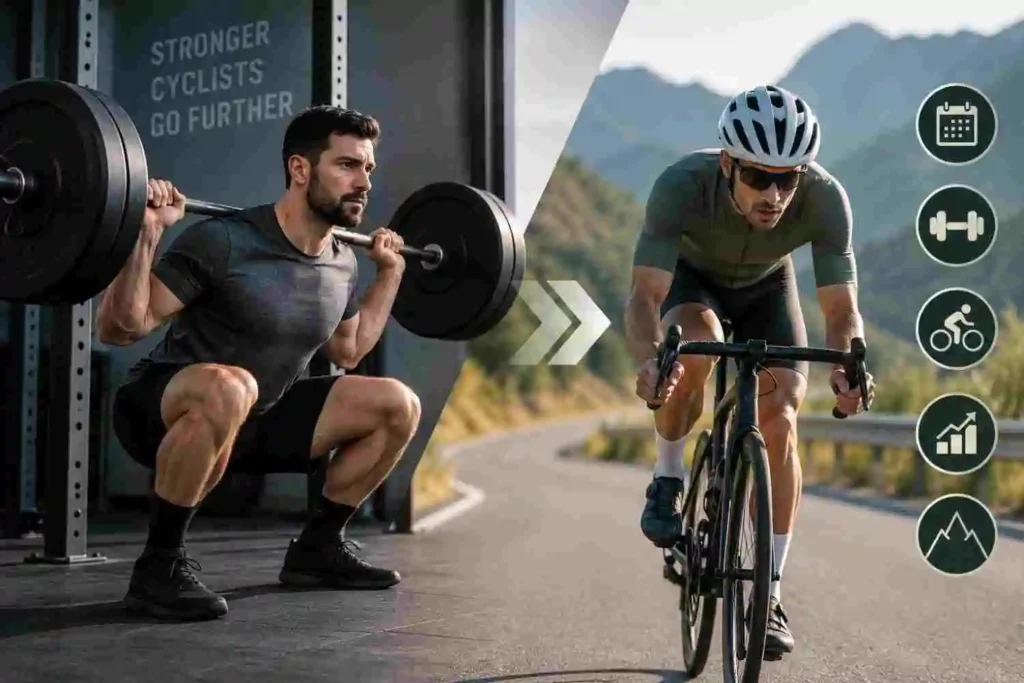
Why Cyclists Should Include Strength Training
Cycling feels like a pure endurance sport, but every pedal stroke is really a repeated burst of force from one leg at a time. How much force you can produce, and how long you can keep producing it, comes down to muscle strength just as much as fitness.
1. It Fixes What Cycling Breaks
Riding the same motion for hours, week after week, builds strong quads and not much else. Your glutes and hamstrings end up underused, and your core spends the whole ride bracing instead of actually working.
2. It Makes You Faster
A 2025 systematic review and meta-analysis covering 17 studies and 262 cyclists found that heavy strength training produced a meaningful improvement in cycling efficiency and anaerobic power, with no real change in VO2max.
That last part matters: it tells you the improvement comes from your nervous system learning to recruit muscle more effectively, not from a fitness gain you could get through more riding alone.
A separate 12-week trial with 36 trained road cyclists backed this up directly on the bike: the group that added conventional strength training gained noticeably more peak power at every test duration (5 seconds, 60 seconds, 5 minutes, and 20 minutes) than a group doing core work only, or no gym work at all.
3. It Helps Prevent Injuries
Knee pain, IT band flare-ups, and a sore lower back are all common in cyclists, and weak hips or a weak core are usually the reason why. When those muscles can’t do their job, your knees and spine end up absorbing load they were never meant to handle. Strength work builds the joint stability and functional strength that let you hold good form on hour four of a climb, not just hour one.
The 12-Week Cyclist Strength Training Framework at a Glance
| Phase | Weeks | Main Goal | Reps × Sets | Intensity | Rest | Focus |
|---|---|---|---|---|---|---|
| Anatomical Adaptation | 1–4 | Movement quality, prepare joints and tendons | 12–15 × 3 | 50–65% of 1RM | 60–90 sec | Technique, fix imbalances |
| Maximum Strength | 5–8 | Build raw force | 4–6 × 4 | 75–85% of 1RM | 2–3 min | Heavy compound lifts |
| Power and Conversion | 9–12 | Turn strength into speed | 3–5 × 3–4, explosive | 30–50% for speed work, 85%+ on peak sets | 2–3 min | Plyometrics, race specificity |
Strength Phase 1: Anatomical Adaptation (Weeks 1–4) for Joint Stability
This phase acts as a warm-up for your body, preparing you for harder training ahead.Light to moderate weights and higher reps help build proper form and prepare your joints and tendons before heavier training.You’ll probably feel some muscle soreness in week one. That’s normal, and it should ease off by week three as your body adjusts.
Training Frequency: Perform 2 strength sessions per week, with at least 48 hours between sessions.
Lifting Tempo: Lower the weight for 3 seconds, pause for 1 second, then lift for 1 second.
Exercise 1: Front Squat or Goblet Squat — 3 sets of 10–12 reps. Builds quadriceps strength and hip control. Keep your chest upright and knees tracking in line with your feet.
Exercise 2: Single-Leg Romanian Deadlift — 3 sets of 10 reps per side. Strengthens the hamstrings and glutes while helping correct left-to-right strength imbalances.
Exercise 3: Standing Overhead Press — 3 sets of 10 reps. Builds shoulder and upper-back strength, which can support a stable position on the bike.
Exercise 4: Pallof Press — 3 sets of 12 reps per side. Develops anti-rotation core strength, helping you maintain better pelvic and trunk stability while riding.
Strength Phase 2: Maximum Strength (Weeks 5–8) for Raw Torque & Force
Weights get heavier, reps decrease, and you rest for 2–3 minutes so you can maintain good form and effort. Deadlifts are especially useful here because they build strong posterior chain muscles and work well with heavy back squats and leg presses. This phase often leads to noticeable strength gains and can make tough climbs feel easier.
Training Intensity: Use 80–87% of your 1RM and rest 2–3 minutes between sets to maintain strength and lifting quality.
Exercise 1: Trap Bar Deadlift — 4 sets of 4–6 reps. Builds posterior chain strength while allowing heavy loading with relatively manageable lower-back stress. Drive through your mid-foot and keep your spine neutral.
Exercise 2: Bulgarian Split Squat — 3 sets of 5 reps per leg. Develops single-leg strength, leg drive, and knee stability, all important for efficient cycling.
Exercise 3: Single-Arm Dumbbell Row — 3 sets of 6 reps per side. Strengthens the upper back and pulling muscles, helping maintain a stable position during standing climbs.
Exercise 4: Ab Wheel Rollout — 3 sets of 8 reps. Builds core bracing strength, helping you stay stable and transfer force efficiently during high-torque pedal efforts.
Strength Phase 3: Power & Race-Specific Conversion (Weeks 9–12) for Explosive Speed
This phase focuses on power, speed, and explosive strength, helping you turn the strength built in Phase 2 into faster, more powerful cycling. You’ll use plyometric exercises such as box jumps, jump squats, and medicine ball throws, along with lighter, faster lifts performed with maximum speed.
The goal is to improve sprinting, acceleration, cadence changes, and power out of corners, so you can produce force quickly when cycling demands it.
- Exercise 1: Explosive Kettlebell Swings — 4 sets of 8 reps. Develops rapid hip extension for attacks, accelerations, and short bursts of power.
Exercise 2: Plyometric Box Jumps — 3 sets of 5 reps. Improves explosive power and neuromuscular response. Land softly with your knees slightly bent and maintain control.
Exercise 3: Single-Leg Step-Up Jumps — 3 sets of 4 reps per leg. Builds single-leg explosive power, helping replicate the quick acceleration and force production needed during hard efforts on the bike.
Best Strength Training Exercises for Cyclists
Leg strength basics: back squat, front squat, leg press, walking lunges.
Deadlifts and posterior chain: cycling can leave the glutes and hamstrings undertrained, so these are essential for balanced lower-body strength. Conventional or trap bar deadlift, Romanian deadlift, hip thrust, kettlebell swing.
Single-leg exercises: cycling involves repeated single-leg force production, so unilateral work improves balance and corrects left-right imbalances. Bulgarian split squat, step-ups, single-leg press, single-leg Romanian deadlift.
Core and trunk stability: a strong core helps you hold a stable riding position and transfer power efficiently without wasted upper-body movement. Pallof press, dead bug, side plank with reach, weighted carries.
Upper body and accessory work: supports bike control, sprinting, and posture on long rides. Push-ups or bench press, single-arm dumbbell row, kettlebell carries or halos, face pulls.
A 12-week strength training program for cyclists
A 12-week strength training program for cyclists works best when strength sessions are balanced with cycling workouts and recovery.
| Day | Focus |
|---|---|
| Monday | Strength Session A: Lower body and core |
| Tuesday | Bike: Easy endurance ride |
| Wednesday | Bike: Intervals or VO₂ max work |
| Thursday | Strength Session B: Posterior chain and upper body |
| Friday | Rest or light active recovery |
| Saturday | Long ride |
| Sunday | Easy recovery ride or full rest |
- Monday – Lower Body & Core: Squats, Romanian deadlifts, walking lunges, calf raises, planks, and dead bugs.
- Tuesday – Easy Endurance Ride: 30–60 minutes of easy cycling at a comfortable, conversational pace.
- Wednesday – Intervals / VO₂ Max: Warm up, then perform hard cycling intervals such as 4–6 × 3–5 minutes at high intensity, with easy recovery between intervals.
- Thursday – Posterior Chain & Upper Body: Hip thrusts, hamstring curls, rows, push-ups or bench press, overhead press, and side planks.
- Friday – Recovery: Easy walking, mobility exercises, stretching, or complete rest.
- Saturday – Long Ride: Steady cycling at an easy-to-moderate endurance pace, gradually increasing duration as fitness improves.
- Sunday – Recovery Ride / Rest: 20–45 minutes of very easy cycling, or take a full rest day if fatigued.
How often should cyclists strength train?
- Off-season / base: 2 sessions per week (3 in the first phase, if your schedule allows), with at least 48 hours between sessions.
- Once racing starts: drop to 1 moderate-intensity session per week. The goal shifts from building strength to maintaining it, so it doesn’t interfere with cycling-specific training.
- Best time to start: the off-season, 10 to 14 weeks before base training begins, since there’s no big riding volume competing for your recovery.
Why the Off-Season Is the Best Time to Do This
Off-season strength training for cyclists works best because there’s no big riding volume competing for your recovery. This is the window to run the full 12-week program at full intensity and build a strength base you’ll draw on all year.
Keeping Your Strength Once Racing Starts
Once the cycling season starts, reduce strength training to one moderate-intensity session per week. The goal is to maintain your strength rather than build more, while supporting cycling power, muscle balance, and joint health throughout a busy race season.
Signs You Need an Extra Rest Day
- Resting heart rate up by 5 or more beats per minute
- Soreness that’s still there after 72 hours
- Power numbers dropping on easy rides
- Sleep that’s noticeably worse than usual
Don't Skip Rest Days
Rest days and easy recovery rides are an important part of your training plan. Light cycling, mobility work, and proper rest help manage training load, reduce fatigue, and lower the risk of overtraining and injury.
Common Mistakes Cyclists Make With Strength Training
- Skipping the first phase: Starting with heavy weights before your tendons and muscles adapt can increase fatigue and injury risk.
- Training legs before a key ride: Heavy leg training the day before an important cycling session can leave you tired and reduce performance.
- Using bodybuilding-style programs: High-volume workouts can create unnecessary fatigue when you’re already cycling several days a week.
- Skipping single-leg exercises: Unilateral exercises help improve leg balance, stability, and strength for the demands of pedaling.
- Skipping post-workout nutrition: Eating too little food around your gym workouts hurts your overall training performance, slows down your muscle recovery, and stops your fitness progress.
Note: For a deeper understanding of how resistance training can support endurance performance, explore our complete guide to strength training for endurance athletes, including exercise selection, training frequency, and practical programming strategies.
Conclusion
Adding a 12-week strength training program for cyclists to your routine is one of the best ways to ride faster and stronger. Instead of just relying on long road rides, lifting heavy weights teaches your nervous system to use more muscle with every pedal stroke.
Scientific studies show that heavy resistance training boosts your sprint power, helps you climb better, and keeps your legs fresh longer without adding bulk or changing your cardio fitness.
Switching from basic core exercises to targeted heavy lifting gives you the extra power needed to break through plateaus and smash your cycling goals.
Frequently Asked Questions
- What is a 12-week strength training plan for cyclists?A 12-week strength training plan for cyclists is a structured, off-season gym program designed to maximize cycling economy, increase Functional Threshold Power (FTP), and improve unilateral force production without adding muscle bulk.
- How does a 12-week strength plan compare to just riding more?A 12-week strength plan improves cycling economy, torque, and injury resilience by 5% to 8% more than just riding additional miles, targeting specific neuromuscular gaps that high-volume pedaling alone cannot fix.
- How can I fit strength training into my cycling week?To fit strength training into your cycling week, separate your high-intensity rides and heavy lifting days by at least 24 hours to maximize recovery and maintain your power-to-weight ratio.
- Compare 2-day vs 3-day strength splits for cyclistsA 2-day strength split is the best choice for most cyclists because it leaves enough energy for regular bike training, while a 3-day split is only useful in the early off-season when riding hours are low and building maximum Functional Threshold Power (FTP) is your main goal.
Author: Nikhil Kumar
Nutrition & Fitness Writer | Health Enthusiast
Nikhil Kumar is a nutrition and fitness writer focused on making evidence-based health information simple, practical, and easy to understand. He has completed a nutrition certification through Coursera and regularly follows current research in nutrition, exercise, fitness, and healthy lifestyle practices.