Winter strength training for cyclists allows riders to build muscle, joint resilience, and power that can’t be developed through riding alone.
A proper off-season program involving heavy squats, single-leg deadlifts, and posterior chain development will generally last between 8 and 12 weeks and yield measurable results in terms of pedal force, sprinting capacity, and injury prevention.
- Builds muscle, joint resilience, and power beyond what riding alone can achieve.
- Periodization protects the block from injury by preventing direct transition to heavy lifting.
- 4-6 week hypertrophy phase builds the muscular and articular foundation for the following strength phases.
- Max strength training develops the neurological and muscular capacity to express this newfound power.
- Posterior chain and unilateral work counteract the quad dominant nature of cycling.
- Appropriate loading schedules allow for progression in both the weight room and on the bike.
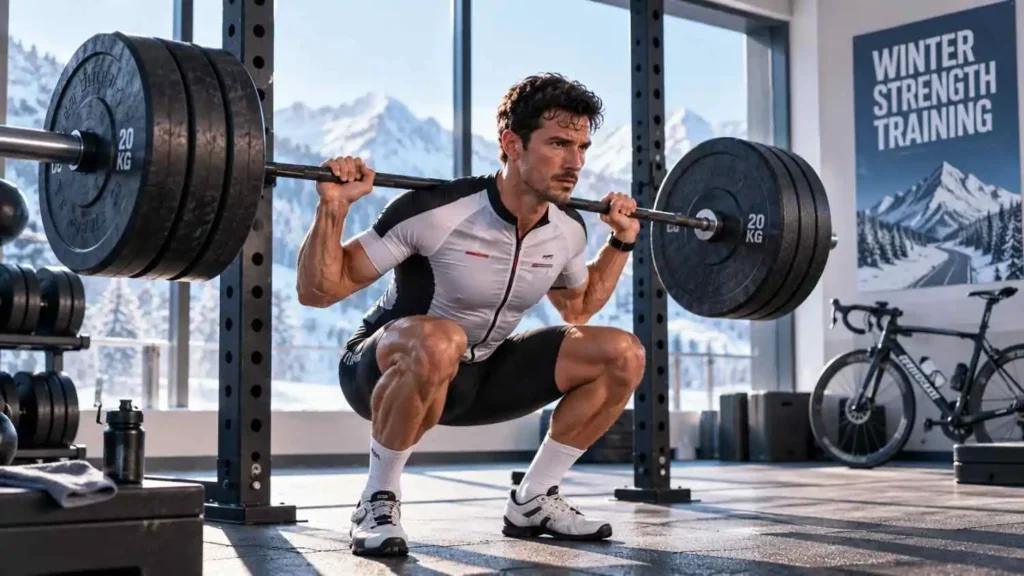
Off Season Training Strategy for Cyclists
A smart off season cycling strength training plan follows periodization, which means that the intensity and goal of your training changes in phases as compared to staying the same throughout the winter. You can injure yourself by jumping into maximal lifts without establishing a foundation first.
Most coaches break up the winter into two or three blocks. Each block has a different point, and you can’t jump ahead because it will compromise the next one.
Understanding the exercise physiology behind these phases helps explain why order matters so much. The body adapts differently to each type of stress, and skipping a phase means missing the specific physiological trigger that phase was designed to create.
Hypertrophy Phase Off Season
The first four to six weeks are hypertrophy-specific, or aimed at building muscle tissue that will be turned into power by higher intensity workouts. These are moderate-load, higher-rep, short-rest programs that allow you to accumulate the physiological adaptation necessary for subsequent phases of training.
A typical program might look like this.
- Three to four sets for each exercise
- Eight to twelve repetitions per set
- Sixty to ninety seconds break between sets
- Focus on the quadriceps strengthening, glutes work, and upper body strength
This stage will also allow you to improve your tendon and connective tissues’ resilience. This workout’s importance is often underestimated by riders since it is less glamorous and requires you to use lighter weights than the maximal. However, it prepares your joints for the following intense workouts in the max strength phase of cycling training.
Max Strength Phase Cycling: Heavy Loading
Once the hypertrophy base has been acquired, the program transitions into a heavy loading program with decreased reps and increased rest intervals.
These are large compound lifts such as heavy squats for cycling power development on the bike. The focus is on higher percentages of one rep max with lower repetitions for sets of three to five, with four or five sets in total.
The emphasis is placed on force production, and it is this quality that will lead to increases in power as the bike rider progresses. The majority of neural adaptation will occur during this phase, teaching the rider how to recruit more motor units at any given time.
Bike riders who utilize a properly designed max strength block will display increases in acceleration and climbing power almost immediately once they return to the bike.
Rest intervals between each heavy set should be two to three minutes to allow for creatine phosphate resynthesis. Too short of a rest period and the rider will fail to get the appropriate adaptation, which will detract from the intended purpose of the session.
Posterior Chain Exercises for Riders
The posterior chain is the group of muscles that is primarily responsible for the pull phase of a pedal stroke, which is largely ignored by many riders.
- Single leg deadlifts for cyclists are one of the top movements in this category because cycling is a unilateral sport.
Romanian deadlifts work the hamstrings and glutes while also promoting hip-hinge strength and control.
Hip thrusts work the glutes directly and help promote hip extension strength.
Back extensions will promote lower back strength and posterior chain endurance.
Pedal Stroke Efficiency Gym Exercises
The pedal stroke involves a coordinated kinetic chain from the foot to the hip, and gym exercises that replicate this kinetic chain are transferred to riding more directly than other movements.
Use these effective strength training exercises for cyclists:
- Front squats will give you strong quads and teach your core to stabilize under load.
- Bulgarian split squats will build strength and power in one leg while challenging your balance.
- Step-ups will prepare you for the pedal stroke by working your legs through a big range of motion.
- Planks and anti rotation core work will teach your core and hips to resist the twisting forces from the pedals.
The core is of particular importance, as it provides the stability needed to ensure that the forces generated by the legs can be transferred efficiently to the pedals, without unnecessary movement of the torso, which will affect overall pedaling efficiency.
Pre-Season Training Transition
The final phase converts raw gym force into sport-specific power. As with overall strength training for endurance athletes, the goal here is to reduce gym volume while increasing explosive speed and velocity.
Incorporate plyometric jumps and high-velocity lifts.
Align resistance work with increasing indoor trainer intensity.
Reduce total gym frequency to preserve freshness for outdoor rides.
Sample Weekly Winter Strength Training for Cyclists
Monday
Primary Focus: Lower Body Max Strength
Exercises: Barbell Squats, Deadlifts
Intensity & Volume: Heavy (3–5 reps, 85%+ 1RM)
Tuesday
Primary Focus: Indoor Trainer Z2
Exercises: Endurance Ride
Intensity & Volume: Aerobic Base
Wednesday
Primary Focus: Upper Body & Core Strength
Exercises: Overhead Press, Rows, Planks
Intensity & Volume: Moderate (8–10 reps)
Thursday
Primary Focus: Unilateral Strength
Exercises: Single-Leg Deadlift, Lunges
Intensity & Volume: Moderate (6–8 reps per leg)
Friday
Primary Focus: Active Recovery
Exercises: Mobility Work, Stretching
Intensity & Volume: Low Intensity
Saturday
Primary Focus: High-Intensity Indoor Session
Exercises: Sweetspot or Threshold Intervals
Intensity & Volume: High Bike Load
Sunday
Primary Focus: Off
Exercises: Rest
Intensity & Volume: Full Recovery
Core and Upper Body Integration
A strong upper body and a strong core provides better control and power from the cyclist at the handlebars. Because of that, winter training for cyclists should include core workouts along with lower-body and upper-body workouts.
- Heavy carry exercises aid the core in stabilizing it against rotational forces.
- Renegade rows work on the upper back, shoulders, and core, enabling the cyclist to hold an aerodynamic position better and for a longer period.
- Planks can help develop the stability required to stay in a strong position on steep climbs.
The Five Essential Lifts for Cycling Speed
To maximize strength gains while avoiding a waste of time, it’s important to focus on the most productive exercises.
- Barbell Back Squats build quad strength and power production during the downward phase
- Conventional Deadlifts work the glutes and lower back to help you maintain aggressive riding positions for long periods of time
- Single Leg Deadlifts work on balance and utilize specific hip stabilizers
- Bulgarian Split Squats build single leg strength under load
- Weighted Planks create tension throughout the body to keep you stable during heavy efforts.
Indoor Trainer Strength Balance and Load Management
Combining heavy lifting with high intensity indoor cycling demands strict attention to overall level of strain. Improper balancing of your workload will make you overstrained and will ruin your progress at both gyms.
Schedule your heavy lower body gym days in the same days as your hard bike workouts and keep easy days as rest days.
Make sure to take at least six hours between a lifting session and a biking session if you are going to have two sessions per day.
Cut the amount of volume in the gym if it drops unexpectedly on your bike.
Muscle recovery depends heavily on protein intake and quality sleep, both of which determine how quickly the body repairs tissue damage from heavy lifting sessions.
Final Takeaway
Winter strength training for cyclists works by progressing through muscles, then to heavy weights, and finally the bike gets to turn all that into speed when racing starts. By continuing to attend this, you can soon start to see that you’re not starting from scratch.
Author: Nikhil Kumar
Nikhil Kumar is a Nutrition & Fitness Writer. He makes complex topics on nutrition, fitness, and healthy living easy to understand. Nikhil has a nutrition certificate from Coursera and tries to stay updated with the latest studies and research.