A food nutrition comparison shows which foods give the most protein, calories, carbs, and vitamins for the least money. Below, eggs, tuna, lentils, dairy, protein powders, plant milks, and fruits are compared using USDA FoodData Central values and typical Walmart, Costco, Aldi, and Kroger prices.
The RDA for protein is 0.8 g per kg of body weight.
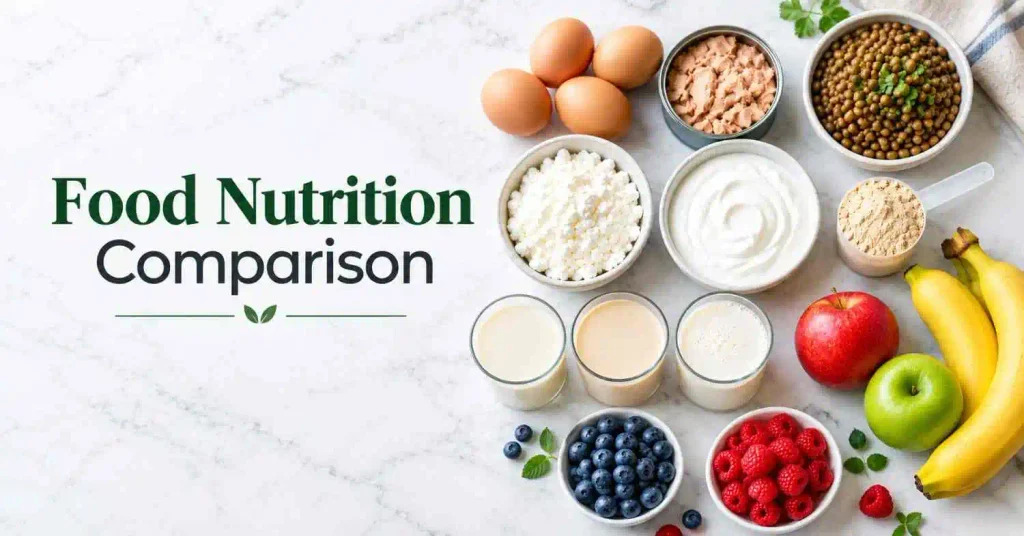
Food Nutrition Comparison: Which Protein Is Cheapest?
Cheapest protein: Lentils ($0.01 to $0.02 per gram)
Lentils give the most protein for the least money. Eggs and cottage cheese follow at $0.04 to $0.07. Canned tuna and Greek yogurt cost slightly more but are the easiest to eat on busy days.
| Food Item | Serving Size | Protein (g) | Calories | Carbs (g) | Avg Cost per Serving ($) | Key Advantage |
|---|---|---|---|---|---|---|
| Eggs | 2 large | 12-13 | 143 | 1 | 0.40-0.90 | Complete protein, B12, choline |
| StarKist chunk light tuna | 5 oz can | 20-25 | 100-120 | 0 | 1.20-2.00 | Shelf-stable, selenium |
| Cottage cheese (2%) | 1 cup | 24-27 | 180-200 | 8-10 | 1.00-1.80 | Slow-digesting casein, calcium |
| Lentils (cooked)Cheapest | 1 cup | 18 | 230 | 40 | 0.20-0.35 | Cheapest, folate, iron, fiber |
| Plain nonfat Greek yogurt | 3/4 cup | 17-18 | 90-100 | 6-7 | 0.90-1.50 | Live cultures, calcium |
Which one should you pick?
Best for muscle building
Eggs and cottage cheese. Both supply leucine and a full set of essential amino acids (EAAs) that support muscle protein synthesis (MPS).
Best for fat loss on a budget
Lentils and canned tuna. Lentils bring fiber and fullness, and tuna adds protein with very few calories.
Trade-off: Lentils are an incomplete protein on their own and contain anti-nutrients like phytates. Soaking and cooking reduces them, and pairing lentils with rice or grains fills the amino acid gaps.
Pro Tip: Buy dry lentils by the pound at Aldi or Walmart, and buy eggs by the 18-count at Costco. Both are easy bulk buying strategies against grocery inflation.
What Is the Difference Between Skyr, Greek Yogurt, and Cottage Cheese?
- Skyr and Greek yogurt are strained dairy products that are thick and high in protein.
- Skyr is milder and creamier.
- Cottage cheese has soft curds, more sodium, and the lowest cost per gram of protein.
Nutrition is close, so choose the one you will actually finish.
| Food Item | Serving Size | Protein (g) | Calories | Carbs (g) | Avg Cost per Serving ($) | Key Advantage |
|---|---|---|---|---|---|---|
| Greek yogurt, nonfat (Fage, Chobani) | 3/4 cup | 17-18 | 90-100 | 6-7 | 0.90-1.60 | Probiotics, easy to find |
| Skyr, nonfat (Siggi’s) | 5.3 oz | 15-17 | 80-110 | 6-8 | 1.30-1.90 | Thickest, mild taste |
| Cottage cheese, 2% (Good Culture) | 1/2 cup | 12-14 | 90-100 | 4-5 | 0.60-1.00 | Best price per gram |
Is skyr just Greek yogurt?
No. Both are strained, high-protein dairy products, but skyr is Icelandic, made from skim milk, and usually thicker and milder. Technically skyr is a fresh strained cheese, but it is sold and eaten as yogurt.
Can you mix Greek yogurt with cottage cheese?
Yes, it works really well. Blend Greek yogurt and cottage cheese 1:1 and you get a smooth, high-protein base for cheesecake, dips, or ice cream. A Ninja Creami is a popular pick for the ice cream version.
Blending also gets rid of the curd texture that puts some people off cottage cheese, so the final result feels creamy instead of lumpy.
For a protein cheesecake, add a scoop of protein powder. If you want a little extra flavor, a spoon of peanut butter goes a long way.
Whey vs. Plant-Based Protein Powder: Which One Is Worth It?
Whey is usually higher in leucine and absorbs faster. A good plant blend is a solid dairy-free option with a bit less per scoop and a slightly higher price.
| Food Item | Serving Size | Protein (g) | Calories | Avg Cost per Serving ($) | Key Advantage |
|---|---|---|---|---|---|
| Whey concentrate/blend (Optimum Nutrition Gold Standard) | 1 scoop (31 g) | 24 | ~120 | $0.90-1.50 | High leucine, strong value |
| Whey isolate | 1 scoop (~30 g) | 25-27 | 110-130 | $1.20-2.00 | Low lactose, very low fat |
| Plant-based powder (Orgain Organic) | 2 scoops (46 g) | ~21 | ~150 | $1.20-1.80 | Dairy-free, pea and rice blend |
| Ready-to-drink shake (Premier Protein) | 11.5 fl oz | 30 | 160 | $1.60-2.50 | Zero prep, grab-and-go |
What is the difference between whey isolate and whey concentrate?
Whey concentrate is roughly 70-80% protein with a little lactose and fat. Whey isolate is filtered to about 90% protein or more, so it suits people who are lactose-sensitive. Both deliver a complete amino acid profile, including BCAAs and about 2.5-3 g of leucine per scoop, which is around the amount used to trigger MPS.
Is plant-based protein powder as good as whey?
Close, with a caveat. Pea alone is lower in methionine, and rice is lower in lysine. Blends fix this, and most good plant powders combine them. You may need a slightly larger scoop to match whey’s leucine. Plant formulas also tend to cost a bit more per gram of protein.
Which protein powder is best for your goal?
- Best for muscle building: Whey concentrate or isolate
- Best for lactose sensitivity: Whey isolate or a plant blend
- Best dairy-free option: A pea and rice blend
Pro Tip: Look for third-party testing seals like NSF Certified for Sport or Informed Choice, especially for plant-based powders.
Almond vs Oat vs Soy Milk: Which Is Healthiest?
Soy milk is the closest nutritional match to dairy milk. Almond milk is the lowest in calories, and oat milk is the creamiest but has the most carbs.
| Food Item | Serving Size | Protein (g) | Calories | Avg Cost per Serving ($) | Key Advantage |
|---|---|---|---|---|---|
| Soy milk, unsweetened (Silk) | 1 cup (8 fl oz) | 7-8 | 70-80 | $0.25-0.45 | Highest protein of the plant milks |
| Almond milk, unsweetened (Silk) | 1 cup (8 fl oz) | 1 | 30-40 | $0.25-0.45 | Lowest calories and sugar |
| Oat milk, original (Oatly) | 1 cup (8 fl oz) | 3 | ~120 | $0.40-0.70 | Creamy texture for coffee and smoothies |
| Whole dairy milk (reference) | 1 cup (8 fl oz) | 8 | ~150 | $0.25-0.35 | Complete protein, naturally has calcium |
Which plant-based milk is healthiest?
Best dairy-free alternative for protein
Soy milk. It is the only plant milk here with protein close to cow’s milk.
Best for low calories
Unsweetened almond milk, though it adds almost no protein.
Best for coffee and texture
Oat milk. It has about 7 g of sugars per cup from the oats themselves and a higher glycemic index, so go easy if you are watching blood sugar.
Banana vs. Apple vs. Berries: Which Fruit Has the Best Macros?
| Food Item | Serving Size | Protein (g) | Calories | Avg Cost per Serving ($) | Key Advantage |
|---|---|---|---|---|---|
| Banana (medium) | 1 fruit (118 g) | 1.3 | ~105 | $0.20-0.30 | Cheapest, ~14 g sugar, 3 g fiber |
| Apple (medium) | 1 fruit (182 g) | 0.5 | ~95 | $0.60-1.00 | ~19 g sugar, 4 g fiber, travels well |
| Blueberries | 1 cup (148 g) | 1.1 | ~84 | $1.00-2.00 | ~15 g sugar, rich in antioxidants |
| Raspberries | 1 cup (123 g) | 1.5 | ~64 | $1.50-2.50 | Only ~5 g sugar, 8 g fiber |
Which is healthier: a banana or an apple?
Neither wins outright. A medium apple has slightly fewer calories (~95 vs ~105) and a bit more fiber (4 g vs 3 g), while a banana costs less and gives more potassium. Choose an apple for fullness and a banana for quick energy.
Is a banana a berry?
Yes, botanically. A banana grows from a single flower’s ovary and is fleshy with seeds inside, which fits the definition of a berry.
Which fruit is best for weight loss?
Raspberries and other berries. They have the least sugar and the most fiber per calorie. Fruit sugar is natural sugar, and the fiber slows its absorption, which is very different from added sugars in sweetened foods.
How Do You Build a High-Protein, Low-Cost Grocery Cart?
- Protein: Eggs, dried lentils, tinned tuna, own-brand cottage cheese
- Dairy/probiotic: Large tub of plain Greek yoghurt/skyr
- Carbohydrates/fibre: Bananas, apples, frozen berries, oats.
- Whey/plant protein (one tub only if you’re struggling to hit your target)
- Soy milk (dairy free option): Unsweetened soy milk.
Look at the unit price (price per ounce) on the shelf. This will help to give an idea of how much each gram of protein will cost.
Which Is Better: Homemade Smoothies or Packaged Energy Drinks?
Homemade smoothies are better for most people. They give real protein, fiber, and vitamins for about $1.50 to $2.50 a serving. Packaged energy drinks mostly give caffeine and sugar with little or no nutrition, and cost about the same per can.
| Food Item | Serving Size | Protein (g) | Calories | Carbs (g) | Avg Cost per Serving ($) | Key Advantage |
|---|---|---|---|---|---|---|
| Homemade protein smoothie (Greek yogurt, banana, berries, milk) | 16 fl oz | 20-25 | 250-300 | 35-40 | 1.50-2.50 | Protein, fiber, potassium, calcium |
| Homemade fruit smoothie (banana, berries, soy milk) | 16 fl oz | 6-8 | 220-250 | 45-50 | 1.20-2.00 | Vitamin C, natural sugars, cheap |
| Red Bull | 8.4 fl oz | 0 | 110 | 27 | 1.80-2.50 | Quick caffeine (80 mg) |
| Monster Energy | 16 fl oz | 0 | 210 | 54 | 2.00-3.00 | High caffeine (160 mg), high sugar |
| Celsius | 12 fl oz | 0 | 10 | 2 | 1.80-2.50 | Zero sugar, 200 mg caffeine |
| Bottled smoothie (Naked, Bolthouse) | 15.2 fl oz | 2-3 | 260-300 | 55-65 | 3.50-4.50 | Convenient, but sugar heavy |
Conclusion: Balancing Protein, Calories, and Budget
A food nutrition comparison works best when you compare foods per gram of protein, not per package. Build your cart on lentils, eggs, tuna, and cottage cheese, then add plain Greek yogurt and fruit. Use protein powder only to fill gaps, and check protein, calories, carbs, and unit price before you buy.
Frequently Asked Questions
- How do you do a food nutrition comparison?Compare foods per the same serving size or per 100 g, then check protein, calories, carbs, and price per gram of protein. Using USDA FoodData Central values keeps the numbers consistent across foods.
- What are the key differences between skyr and Greek yogurt?Skyr is Icelandic, made from skim milk, and usually thicker and milder. Greek yogurt is tangier, and its texture varies with fat level. Both are strained and high in protein, so their nutrition is close.
- Is it better to eat cottage cheese or Greek yogurt for weight loss?Both work. Greek yogurt gives more protein for similar calories (17-18 g vs 12-14 g at 90-100 calories), while cottage cheese costs less per gram of protein. Pick the one you will actually finish.
- What are the downsides of skyr?Skyr costs more than Greek yogurt and cottage cheese and can be harder to find. Flavored versions often have added sugar, and it still contains milk protein and some lactose, so it does not suit a dairy allergy.
- What has more protein, 2 eggs or a cup of Greek yogurt?Greek yogurt. It has about 23 g of protein per cup (17-18 g per 3/4 cup), versus 12-13 g in 2 large eggs. Eggs cost less per serving and add choline and B12.
- Which is better, almond milk or soy milk?Soy milk is better for protein (7-8 g vs 1 g per cup). Almond milk is better for low calories (30-40 vs 70-80 per cup). Choose soy for nutrition and almond for fewer calories.
- How do oat milk and soy milk taste different?Oat milk tastes sweeter and creamier, which suits coffee. Soy milk is more neutral with a mild nutty, slightly beany flavor that works well in smoothies and cooking.
- Can you crossbreed a banana and an apple?No. Bananas belong to the Musaceae family and apples to the Rosaceae family, which are too distantly related to produce a hybrid.
Author: Nikhil Kumar
Nutrition & Fitness Writer | Health Enthusiast
Nikhil Kumar is a Nutrition & Fitness Writer passionate about making evidence-based wellness simple and actionable. After completing a nutrition certification via Coursera, he continuously follows the latest research on food, movement, and longevity. His mission is to provide trustworthy, practical guidance that helps readers achieve their health goals confidently.
Source&References: https://fdc.nal.usda.gov/