Strength training for beginner triathletes can be described as a properly designed resistance exercise program that is performed twice a week. It generally aims to improve muscle strength and joint stability, leading to higher resistance and decreased risk of injuries during a triathlon event.
A triathlon training program for beginners should include bodyweight exercises only at the starting point and allow the addition of external loads such as dumbbells, kettlebells, and resistance bands.
Key Takeaways
- Train twice weekly: Two 30 to 45 minute sessions are enough.
- Start simple: Begin with bodyweight exercises, then add dumbbells, kettlebells, or bands.
- Focus on key movements: Squats, lunges, rows, push-ups, and planks cover the essentials.
- Progress gradually: Add weight or reps slowly to avoid injury.
- Prioritize recovery: Rest days help your body adapt and perform better.
Benefits of Strength Training for Triathletes
The benefits of strength training go well beyond increases in size and strength. Resistance training can improve the efficiency of force production in three sporting areas.
- Injury prevention: increased musculature, tendon, and connective tissue resilience provide greater protection from the repeated stress of hours of running and pedaling.
- Running economy: improved lower-body strength decreases the energetic cost of running at a given pace.
- Cycling power: increased gluteal and quadriceps strength produces higher wattage output on the bike.
- Swim propulsion: upper-body strength training increases forward propulsion, while improving stability in the shoulder girdle.
- Fatigue resistance: core strength allows a competitor to maintain proper form throughout the entirety of a race.
- Durability: stronger joints can better withstand the stress of higher weekly training loads.
Why Strength Training for Beginner Triathletes Is Non-Negotiable
The complex biomechanics of triathlon are characterized by a large amount of movements performed in a repetitive manner. These movements affect the muscles and joints of different planes in relation to each other. In order to develop the whole body, a serious athlete needs to perform a set of isolated strength-building exercises.
The lack of structural balance in the body often leads to the appearance of overload in tissues and cells during active participation in triathlon competitions. Comprehensive training strengthens the ligaments and joints, increasing the overall resistance of the body to destructive effects during repeated exercises.
Swim, Bike, and Run Movement Patterns
- Swimming: Shoulders, lats, and trunk rotate to generate pull and maintain body position.
- Cycling: Hips, knees, and ankles repeat a fixed, seated, single-plane motion.
- Running: Each stride demands single-leg stability, hip extension, and impact absorption.
Essential Strength Exercises: Key Exercises for Triathletes
Key exercises for triathletes target multi-joint movement patterns. Beginners need six to eight movements, not dozens.
Lower Body Strength Exercises
- Goblet squat – works the quadriceps, glutes, and core. Can be done with a single dumbbell or kettlebell.
- Romanian deadlift – works the hamstrings and glutes.
- Reverse lunge – works one leg at a time and the core.
- Step-up – simulates the pedal stroke of a bike and the powerful thrust of a sprinter.
- Glute bridge – isolates the glutes and can be done with minimal equipment.
Upper Body Strength Exercises
- Push-up: Builds chest, shoulder, and triceps strength plus core bracing.
- One-arm dumbbell row: Strengthens lats and upper back for swim pull.
- Band pull-apart: Reinforces rear shoulders and posture.
- Overhead press: Improves shoulder stability and overhead control.
Core Strength Exercises
- Plank: Trains anti-extension strength across the entire trunk.
- Side plank: Targets lateral stability for running and cycling.
- Dead bug: Teaches core control while the limbs move.
- Pallof press: Builds anti-rotation strength with a band.
Warm-Up Routines and Cool Down Techniques
A proper warm-up increases the temperature of the muscles and prepares them for specific movements. A cool down decreases the heart rate and initiates the recovery process.
Warm-Up Routines
- Warm up for 8 to 10 minutes using dynamic stretching and activation exercises:
- Leg swings – to open up the hips for squatting and lunging.
- World’s greatest stretch – to mobilize the hips, thoracic spine, and hamstrings.
- Glute bridges – to activate the glutes before squatting and lunging.
- Arm circles – to prepare the shoulder girdle for pressing and pulling movements.
Cool Down Techniques
- Easy walking – to slowly bring the heart rate down to a resting state within 3 to 5 minutes.
- Static stretching – to lengthen the muscles used during the training.
- Foam rolling – to release tension in the quads, calves, and upper back. Spend 30 to 60 seconds on each area.
Programming Guidelines for Beginners
The guidelines for beginners are simple. Start light, learn technique, and add load gradually.
Frequency of Workouts
Two sessions weekly suit most beginner triathletes. A third session adds little benefit and raises fatigue risk. Separate strength days from hard run or bike sessions when possible.
Reps and Sets
Beginners do two or three sets of eight to twelve repetitions. Use a weight that allows you to do two more repetitions. Take a break of 60 to 90 seconds between sets.
Duration of Workouts
Keep your workouts between 30 and 45 minutes long. Shorter sessions provide more benefits for your body.
Progressive Overload
Progressive overload means a gradual increase in the amount of stress placed on the body during training. To do this, you can increase the weight you lift by about five percent, do one more repetition, or slow down the time when you are lowering the weight. Only change one thing at a time.
Training Phase Adjustments
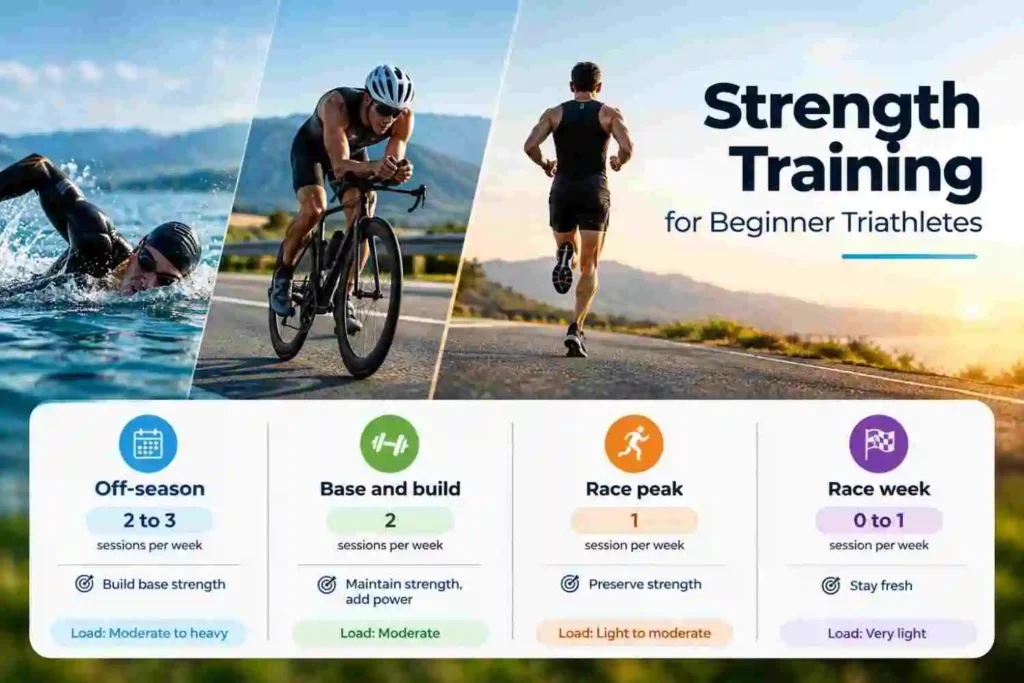
| Training Phase | Sessions per Week | Focus | Load |
|---|---|---|---|
| Off-season | 2 to 3 | Build base strength | Moderate to heavy |
| Base and build | 2 | Maintain strength, add power | Moderate |
| Race peak | 1 | Preserve strength | Light to moderate |
| Race week | 0 to 1 | Stay fresh | Very light |
Overtraining Syndrome Warning Signs
Overtraining syndrome occurs due to excessive overload, which can be overwhelming for the body. Therefore, it is paramount to recognize the symptoms of overtraining:
- Chronic fatigue
- Decrease in performance
- Increased resting pulse
- Irritability and loss of motivation
- Higher occurrences of illnesses
What mistakes slow beginners down?
- Lifting too heavy too soon: Poor technique under heavy load raises injury risk.
- Skipping strength during race season: Muscle and tendon resilience fade without maintenance.
- Scheduling before key sessions: Heavy leg days before intervals reduce workout quality.
- Neglecting mobility: Tight hips and shoulders limit swim, bike, and run mechanics.
Conclusion: Build a Durable Foundation
Strength training for beginner triathletes is easy. Two short weekly sessions, a few core movements, plus gradual progressive overload can make all the difference in developing a strong core, powerful glutes, and more stable joints.
Starting with bodyweight exercises and progressing to dumbbell and band work while also protecting recovery can lead to serious strength and power gains for triathletes of all levels.
Frequently Asked Questions
- How often should beginner triathletes lift weights?Beginner triathletes need to do strength training twice a week. Each session should last 30-45 minutes.
- Why is strength training for beginner triathletes important?It improves your running economy, increases your cycling power, and makes your swims more powerful, all while decreasing your risk of overuse injuries.
- Will strength training make triathletes too heavy or slow?No. Strength training, even low-volume, moderate-rep programs, will build functional strength without a lot of hypertrophy, and the increase in strength will usually improve your speed and durability.
- Can beginners do strength training without a gym?Yes. Bodyweight exercises, resistance bands, and a single kettlebell or pair of dumbbells will cover all the key movement patterns.
- When should triathletes strength train during the week?Pair strength workouts with hard endurance days, or after easy workouts. This way, easy days are actually easy and recovery is preserved.
- How long before strength training improves race performance?Most beginners report on improvements in steadiness after four to eight weeks of practice. The increase in performance becomes noticeable after 12 weeks of constant training.
Author: Nikhil Kumar
Nutrition & Fitness Writer | Health Enthusiast
Nikhil Kumar is a Nutrition & Fitness Writer passionate about making evidence-based wellness simple and actionable. After completing a nutrition certification via Coursera, he continuously follows the latest research on food, movement, and longevity. His mission is to provide trustworthy, practical guidance that helps readers achieve their health goals confidently.
Source&References
- Umbrella Review of Systematic Reviews and Meta-Analyses (PubMed, 2025): Strength training improves endurance performance and running economy, and helps maintain VO2max in endurance athletes.
https://pubmed.ncbi.nlm.nih.gov/40153564/ - Effects of Strength Training on Running Economy in Highly Trained Runners (PubMed, Journal of Strength and Conditioning Research, 2016): Meta-analysis of controlled trials using 2 to 3 weekly sessions.
https://pubmed.ncbi.nlm.nih.gov/26694507/ - Applying a Holistic Injury Prevention Approach to Elite Triathletes (PMC, 2024): Triathlon-specific injury prevention built on strength training and training load control.
https://pmc.ncbi.nlm.nih.gov/articles/PMC11359884/