Last updated: November 13, 2026
When it comes to chicken thighs vs breast protein, breast has more: about 31g per 100g of cooked, boneless, skinless meat, compared with 25 to 26g for thigh. Breast also has fewer calories (about 165 vs 180 to 210), while thighs win on fat, flavor, and moisture.
Chicken Thighs vs Breast Protein and Nutrients: Full Comparison per 100g
Breast has more protein, niacin, B6, and potassium, while thighs have more fat, calories, iron, zinc, and most other vitamins and minerals.
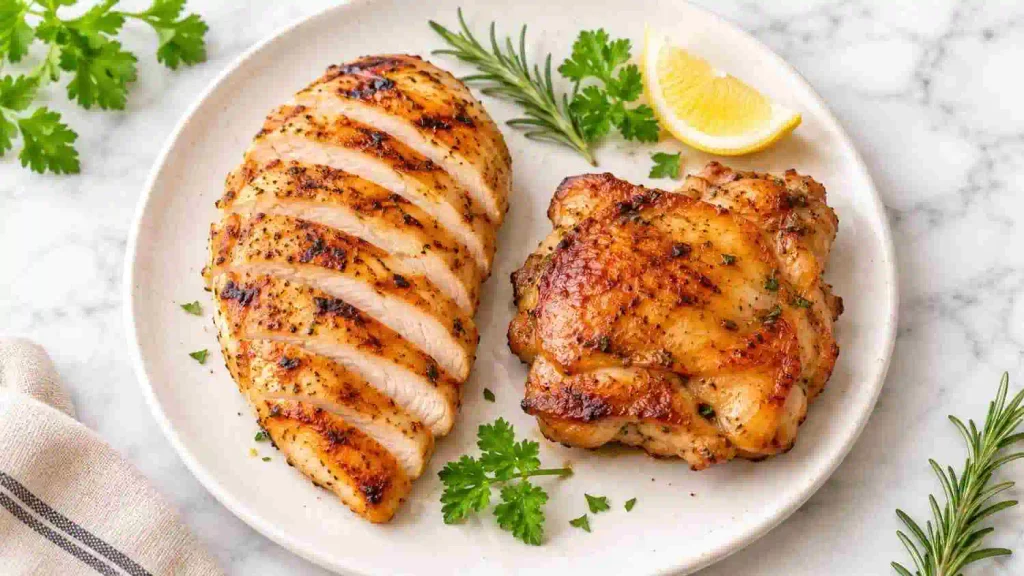
Protein, energy, and carbs
Breast leads on protein, while thigh leads on energy and total fat.
| Nutrient (per 100g, cooked) | Chicken breast | Chicken thigh | Higher in |
|---|---|---|---|
| Protein | 31.0 g | 24.8 g | Chicken breast |
| Energy | 165 kcal | 179 kcal | Chicken thigh |
| Total fat | 3.6 g | 8.2 g | Chicken thigh |
| Water | 65.3 g | 67 g | Chicken thigh |
| Carbohydrate (available) | 0 g | 0 g | Tie |
| Dietary fibre | 0 g | 0 g | Tie |
Roasted, meat only (no skin). Source: USDA FoodData Central.
Fat profile and cholesterol
Thigh has more of every fat type and more cholesterol, but the amounts per 100g are small.
| Nutrient (per 100g, cooked) | Chicken breast | Chicken thigh | Higher in |
|---|---|---|---|
| Saturated fat | 1.0 g | 2.3 g | Chicken thigh |
| Monounsaturated fat | 1.2 g | 3.4 g | Chicken thigh |
| Polyunsaturated fat | 0.8 g | 1.7 g | Chicken thigh |
| Cholesterol | 85 mg | 133 mg | Chicken thigh |
Roasted, meat only (no skin). Source: USDA FoodData Central.
Vitamins
Breast leads on niacin (B3), vitamin B6, and folate, while thigh leads on riboflavin, thiamine, vitamin E, and retinol.
| Nutrient (per 100g, cooked) | Chicken breast | Chicken thigh | Higher in |
|---|---|---|---|
| Niacin (B3) | 13.7 mg | 6.2 mg | Chicken breast |
| Vitamin B6 | 0.60 mg | 0.46 mg | Chicken breast |
| Vitamin E (alpha-tocopherol) | 0.27 mg | 0.18 mg | Chicken breast |
| Folate (B9) | 4 µg | 5 µg | Chicken thigh |
| Riboflavin (B2) | 0.11 mg | 0.22 mg | Chicken thigh |
| Thiamine (B1) | 0.07 mg | 0.10 mg | Chicken thigh |
| Pantothenic acid (B5) | 0.97 mg | 1.30 mg | Chicken thigh |
| Vitamin B12 | 0.34 µg | 0.42 µg | Chicken thigh |
| Vitamin A | 21 IU | 27 IU | Chicken thigh |
Roasted, meat only (no skin). Source: USDA FoodData Central.
Minerals
Thigh leads on zinc, iron, potassium, copper, and sodium, while breast leads on magnesium and calcium. Phosphorus and selenium are practically equal.
| Nutrient (per 100g, cooked) | Chicken breast | Chicken thigh | Higher in |
|---|---|---|---|
| Zinc | 1.00 mg | 1.92 mg | Chicken thigh |
| Iron | 1.04 mg | 1.13 mg | Chicken thigh |
| Potassium | 256 mg | 269 mg | Chicken thigh |
| Phosphorus | 228 mg | 230 mg | Tie |
| Magnesium | 29 mg | 24 mg | Chicken breast |
| Calcium | 15 mg | 9 mg | Chicken breast |
| Sodium | 74 mg | 106 mg | Chicken thigh |
| Copper | 0.049 mg | 0.067 mg | Chicken thigh |
| Selenium | 27.6 µg | 27.1 µg | Tie |
Roasted, meat only (no skin). Source: USDA FoodData Central.
Amino Acid Profiles of Chicken Breast and Thigh
Essential amino acid content per 100g cooked chicken.
| Essential Amino Acid | Chicken Breast (Roasted, Skinless) | Chicken Thigh (Skinless, Cooked) |
|---|---|---|
| Histidine | ~920 mg | ~700 mg |
| Isoleucine | ~1,573 mg | ~1,000 mg |
| Leucine | ~2,500 mg | ~1,800 mg |
| Lysine | ~3,083 mg | ~2,000 mg |
| Methionine | ~850 mg | ~600 mg |
| Phenylalanine | ~1,200 mg | ~900 mg |
| Threonine | ~1,438 mg | ~1,000 mg |
| Tryptophan | ~300 mg | ~200 mg |
| Valine | ~1,660 mg | ~1,100 mg |
Are Raw and Cooked Chicken Macros the Same?
Breast meat (skinless) contains approximately 120 calories, 22-23g of protein per 100g. Thigh meat (skinless) contains approx. 120-140 calories and 19-20g of protein. You must always compare raw to raw or cooked to cooked.
When cooked, 100g of raw breast meat reduces in weight to approximately 75g. However, it retains the same amount of protein (~22-23g) and calories (~120). When increased to 100g of cooked breast meat you can see this increases to ~31g of protein and ~165 calories.
100g of raw thigh meat will reduce to approximately between 75-80g of cooked meat. It retains the same amount of protein (~19-20g) and calories (~120-140). When increased to 100g of cooked meat, this results in the values shown in the table above (~25g protein and ~180 calories).
Skin-On vs Skinless and Bone-In vs Boneless
- Skin-on: about 197 calories per 100g cooked breast, or about 230 to 250 calories per 100g cooked thigh, with noticeably more fat and saturated fat than skinless. Best for crispy chicken thighs.
- Skinless boneless: about 165 calories and 31g protein per 100g cooked breast, or about 180 calories and 25g protein per 100g cooked thigh. It is the easiest version to track.
How Does Pork Compare to Chicken for Protein?
Pork tenderloin is somewhere between chicken thigh and breast. It contains around 143 calories and 26g protein per 100g after cooking. However, higher fat cuts of pork will contain less protein per calorie than both chicken cuts.
How Much Protein Is in Chicken per 100 Calories?
Breast gives about 19g of protein per 100 calories, while thigh gives about 12 to 14g. If you need 150g of protein on a tight calorie budget, high protein chicken breast is the efficient choice.
Which Chicken Cut Is Best for My Goal?
- Fat loss or calorie deficit: Breast is the best choice because it gives you a large portion for few calories. Use thighs once or twice a week to keep meals satisfying.
- Muscle gain or bulking: Thighs work well because the extra calories help and the flavor makes large portions easier to finish.
- Low-carb and keto: Thighs fit better. Both cuts have zero carbs, but the extra fat supports satiety and energy.
- Budget cooking in the US: Thighs, especially bone-in and skin-on, are often cheaper per pound, but bone weight and trimming narrow the gap. Store-brand frozen chicken breast and family packs are usually the best value for breast.
- Heart health or LDL concerns: Choose skinless breast first, skinless thigh second, and skin-on or fried chicken last.
What Internal Temperature Is Safe for Chicken?
165°F (74°C) is the safe internal temperature for all chicken, per USDA.
Breasts should be cooked to and left to rest for 5 minutes. Thigh meat can be cooked safely at 165oF however if you want extra tender meat cook to 175-185oF.
How Do You Cook Chicken Thighs?
- Air fryer: Boneless skinless thighs take 14 to 18 minutes at 380 to 400°F, flipping halfway, while bone-in skin-on thighs take 22 to 28 minutes at 400°F. Pat them dry and use a light oil spray for crispy chicken thighs.
- Baked: Roast at 425°F for 20 to 25 minutes (boneless) or 35 to 45 minutes (bone-in). High heat gives golden chicken thighs with browned edges.
- Grilled/smoked: Grill over medium heat with the lid closed until the thighs reach 175°F or more. For smoked chicken thighs, hold the smoker at 250 to 275°F until they hit the same temperature.
- Pan-seared: Start skin-side down in a lightly oiled pan over medium heat and leave them alone for 6 to 8 minutes before flipping. Finish with a pan sauce such as dijon, gravy, or red wine.
- Braised: Braise in broth, tomatoes, or wine for 35 to 45 minutes, or use a slow cooker, for fall-apart meat. Shred it for pulled chicken thighs and tacos.
- Sous vide: Cook at about 165 to 175°F for 1.5 to 4 hours, then sear. The result is exceptionally tender.
What Are Good Marinades for Chicken Thighs and Breast?
Mix together 3 tablespoons of olive oil, 2 tablespoons of acid, 1 tablespoon of soy sauce or mustard, garlic and spices. Leave to marinate for 2-12 hours.
The thigh works well with stronger flavours such as honey garlic, BBQ, buffalo, tandoori and turmeric. The breast works well with milder flavours such as garlic herb, teriyaki, pesto and lemon.
Plain chicken is naturally gluten free but sauces and breading are often not.
Common Mistakes When Comparing Chicken Thighs vs Breast Protein
- Comparing raw macros to cooked macros during a meat protein comparison
- Ignoring added oil, butter, sauces, and breading in calorie counts
- Skipping the thermometer and cutting into the meat to check
- Cooking cold chicken straight from the fridge at very high heat
- Cooking thin and thick breasts together without pounding
- Slicing breast right out of the pan without resting
- Assuming bone-in weight equals edible weight
- Trusting every protein label claim without checking for added solution
Your action plan:
- Match the cut to your goal: breast for cutting, thighs for flavor and bulking.
- Compare raw to raw and cooked to cooked when tracking macros.
- Count your oil, sauce, and breading.
- Mix both cuts across the week to get variety, nutrients, and better adherence.
Conclusion
In the chicken thighs vs breast protein debate, breast wins on numbers and thighs win on taste. Per 100g cooked, breast gives you about 31g of protein for 165 calories, while thighs give you 25 to 26g of protein for 180 to 210 calories, plus more iron, zinc, and juiciness.
Frequently Asked Questions
- How does chicken thighs vs breast protein compare per 100g cooked?The chicken breast provides around 31g of protein (165kcal) compared to around 25g of protein in the chicken thigh (210kcal), so you’re getting a leaner and more dense source of protein from the chicken breast.
- How can I add more protein with chicken thighs or breast?Pair chicken breast or thighs with protein-rich foods like Greek yogurt sauce, cheese, eggs, lentils, or quinoa.
- Is choosing chicken thighs over breast worth the extra fat?While thighs will give extra fat to add more flavour, juiciness and calories (for bulking/keto), breasts are the best option if you’re trying to cut calories/cholesterol.
- How should I weigh protein density against calories in chicken cuts?Per 100g cooked, breast has about 31g protein and 165 kcal while thigh has about 25g protein and 210 kcal, so breast is leaner and denser.
- How to hit 150g protein with chicken breast or thighs?
You’d need around 485g (approx 800 kcal) of cooked breast or around 600g (approx 1,260 kcal) of cooked thigh. this si ruight gramamr or not
Disclaimer: These are approximate values and can vary depending on how it is cooked, type of chicken used and brand. For individual dietary advice please consult a qualified nutritionist or health care professional.
Author: Nikhil Kumar
Nutrition & Fitness Writer | Health Enthusiast
Nikhil Kumar is a Nutrition & Fitness Writer passionate about making evidence-based wellness simple and actionable. After completing a nutrition certification via Coursera, he continuously follows the latest research on food, movement, and longevity. His mission is to provide trustworthy, practical guidance that helps readers achieve their health goals confidently.
Source&References: https://fdc.nal.usda.gov/
Pingback: Ground Chicken vs Ground Turkey vs Ground Beef: Nutrition
Pingback: Food Nutrition Comparison: 6 Guides to Protein, Calories & Price