
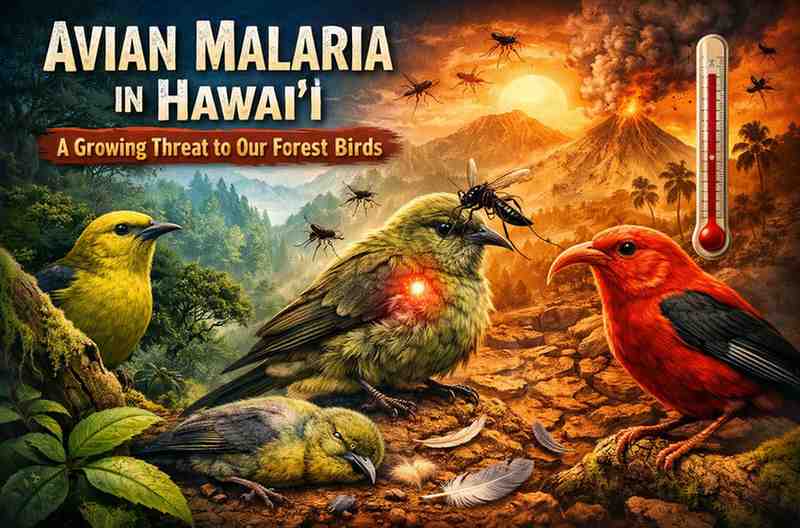
A recent major study has found something quite dreadful: almost all forest birds in the Hawaiian Islands can carry and spread avian malaria.The scientists tested the island birds and found the disease in 63 out of 64 forest locations.
This indicates that avian malaria is not restricted to one specific area but is spread across the islands wherever mosquitoes live.This discovery helps explain why native Hawaiian birds have been slowly decreasing in number for many years.
Table of Contents
ToggleWhat Is Avian Malaria?
Avian malaria is one of the serious diseases affecting birds, caused by a very small parasite called Plasmodium relictum, which lives in the blood of birds that are already infected. The disease is spread through mosquitoes in a simple but dangerous cycle.
First, the mosquito will bite a bird that has avian malaria. It will pick up the parasite. It will develop and grow inside the mosquito. When the mosquito bites another healthy bird, the parasite will be released into the new bird’s bloodstream. It has infected another bird, and the process will start over again. Without the mosquito, avian malaria would be unable to be spread from one bird to another.
Source:
This finding comes from a University of Hawaiʻi at Mānoa study published in Nature Communications that detected avian malaria at 63 of 64 forest sites statewide, showing nearly all Hawaiian forest birds can spread the disease.The main objective is to present the information in a clear and simple way so it can be easily understood by everyone.
Can Avian Malaria and malaria are differenent ?
Yes, they are different.Avian malaria affects birds, and malaria affects humans.
How Avian Malaria Damages Birds?
When a bird gets avian malaria, the parasite attacks its red blood cells, which carry oxygen through the body. These are the ones that transport oxygen within the body. The bird could suffer a lack of sufficient oxygen to keep it healthy. This could cause the blood levels within the body to be extremely low. It could cause a bird to weaken to the point where some of the vital organs of its body could be affected. It could cause the probability of survival to be low. It could actually cause death.
What Did the Study Discover?
The researchers examined over 4,000 birds from the islands of Kauaʻi, Oʻahu, Maui, and Hawaiʻi. They took the birds’ blood samples and conducted laboratory tests to measure the likelihood of the mosquitoes becoming infected after feeding on their blood. The findings were alarming. The parasites were discovered in 63 out of 64 forest areas.. Most forest birds — both native birds and birds brought from other places — were able to pass the parasite to mosquitoes.
Even birds with very small levels of the parasite in the bloodstream could still spread the disease. Some birds were infected for months or even years. This shows that many birds may appear healthy but still have the parasite.
Chronic Infections: The Hidden Danger
However, one of the most significant findings has been that birds are capable of staying infected for a long time. During this time, they just experience minor symptoms of being sick or no symptoms at all. However, when they are bitten by mosquitoes, the infection still spreads. As such, the infection moves through the forest without necessarily being noticed. Scientists have been of the view that this is the reason why avian malaria is still spreading in Hawaiʻi.
Why Mosquito Control Is Essential
Avian malaria completely depends on mosquitoes to spread.If the number of mosquitoes decreases, the transmission of the disease from one bird to another decreases. Thus, fewer birds will be infected, and native birds have a better chance to live and increase in number. This also reduces the chances of extinction for rare species. Because of this, conservation groups are now strongly focusing on mosquito control programs to protect endangered forest birds.
Climate Change Is Fueling the Spread of Avian Malaria
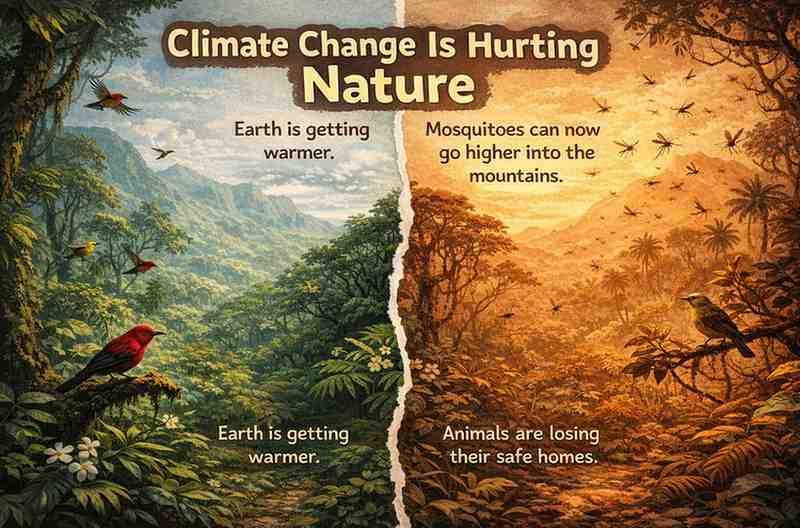
In the past, forests in higher mountain areas were safer because it was too cold for mosquitoes to live there.
- As temperatures rise, mosquitoes can now live in higher mountain areas.
- Places that were once safe for birds are becoming smaller.
- Endangered birds are losing the last safe places where they could survive.
Climate change is expanding the disease zone.
Why This Research Matters
Many diseases spread mainly because of a few important species. But avian malaria in Hawaiʻi is different. Almost every forest bird can help keep the disease spreading. This makes it very hard to stop or remove completely. The study shows that the disease is found in almost all forest areas and has caused serious drops in native bird numbers. Because of this, controlling mosquitoes has now become urgent and very important to protect these birds.
Conclusion:
Almost all forest birds in Hawaiʻi can spread avian malaria, even if they look healthy and show no signs of sickness. This is because many birds carry the parasite in their blood for a long time without appearing ill. When mosquitoes bite these birds, they pick up the parasite and pass it on to other birds. Since mosquitoes are found across most of the islands, the disease keeps spreading again and again.