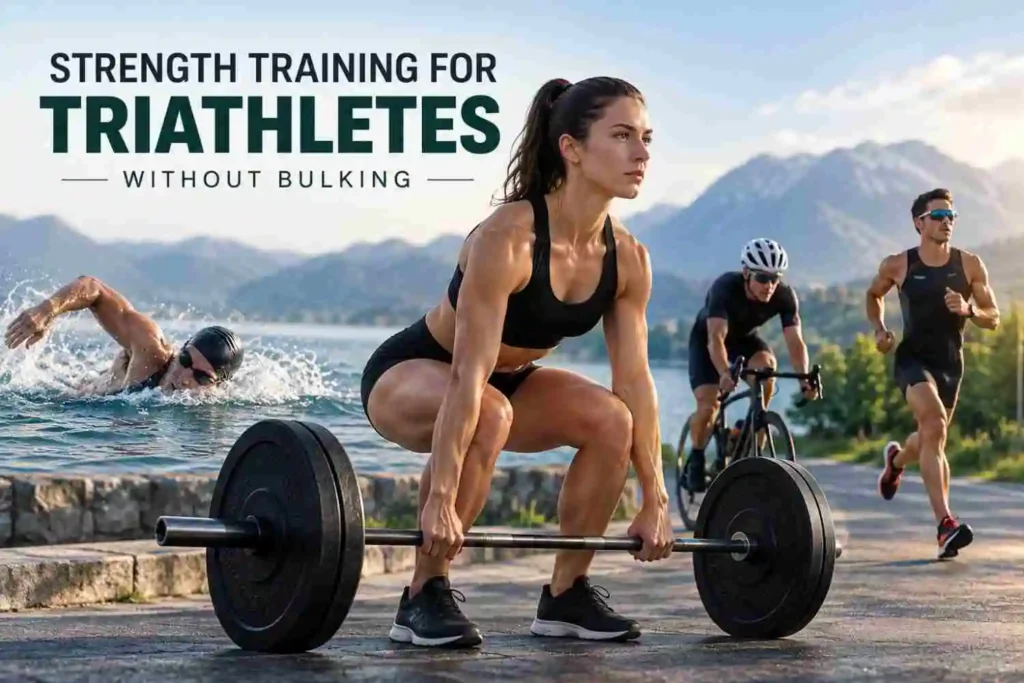
Strength training for triathletes without bulking focuses on getting the muscles to work harder while using low-volume, high-load exercises with a strong focus on producing force. These methods help multi-sport athletes improve muscle activation, strength, and power without adding unnecessary muscle mass or body weight.
- Strength training for triathletes without bulking relies on heavy, low-rep lifting and neural adaptation.
- Maintenance calories + endurance training help limit unwanted muscle growth.
- Focus on strength-to-weight ratio for better swimming, cycling, and running performance.
- Use plyometrics, unilateral exercises, and bodyweight movements to build functional power.
- Two short sessions per week can improve performance, strength, and injury resilience.
Will Lifting Weights Make a Triathlete Bulky?
Strength training does not automatically add size. Hypertrophy requires a calorie surplus, heavy training volume, and moderate repetitions. Triathletes burn thousands of calories doing triathlons weekly, so a surplus almost never occurs.
Think of your body as a car. Hypertrophy builds a bigger engine. Neuromuscular training tunes the engine you already have so it delivers more power without gaining weight. Neuromuscular training is fine-tuning the engine so that it can perform better.
How Do You Start Strength Training for Triathletes Without Bulking?
Start with functional strength training: compound movements that load the kinetic chain. The kinetic chain is the linked system of joints and muscles that passes force from your feet, through your hips and core, to your arms.
Choose 4 to 5 lifts per session and keep reps low. Stop every set with 1 to 2 reps still in the tank.
Which Heavy Lifts Work Best?
- Trap bar deadlift: 3 sets of 3 to 5 reps for hip and leg strength.
- Front or back squat: 3 sets of 3 to 5 reps for running and cycling power.
- Weighted pull-up: 3 sets of 3 to 5 reps for swim pulling strength.
- Overhead press: 3 sets of 4 to 6 reps for shoulder stability.
Why Should Triathletes Use Unilateral Exercises?
Unilateral exercises work one side of the body at a time. Running and cycling are unilateral sports, so unilateral training translates to improved performance on race day and creates balance with lighter loads.
- Bulgarian split squats fill gaps in strength from left to right.
- Single-leg Romanian deadlifts build posterior chain strength.
- Step-ups replicate the pedal stroke, but with resistance.
How Plyometrics Build Explosive Power Without Mass
Plyometric workouts are intensive jumping and hopping exercises. They help to train the tendons to store and release energy like a spring, minimizing energy loss at the point of impact, thereby improving running economy.
These drills are all about building explosive power via your nervous system and tendons, not muscles. Keep them short (2-3 sets of 5-8 reps).
- Pogo hops develop calf/Achilles stiffness.
- Box jumps develop vertical power.
- Broad jumps develop horizontal power.
Can You Use Progressive Overload Without Adding Muscle?
Yes. Increasing the progressive overload can be achieved through different means. Besides adding more weight, a triathlete can utilize other techniques to add intensity and challenge the muscles into greater power and endurance. Some of these techniques include:
Build speed by using the same weight but moving it faster
Increase density by doing the same work in a shorter time
Change to a one-legged version of an exercise to add challenge.
- Add small loads of 2 to 5 percent instead of big jumps.
How Often Should Triathletes Strength Train?
Two workouts per week are ideal for most triathletes during their base training season. Each workout should be thirty to forty-five minutes in duration. This should be done on hard swim, bike, or run days, leaving the easy days as recovery days.
| Training Phase | Sessions/Week | Focus |
|---|---|---|
| Off-Season | 2–3 | Heavy lifting + skill work |
| Base | 2 | Heavy, low-rep strength |
| Build | 1–2 | Maintain strength |
| Peak & Race | 1 short | Low volume + sharp movement |
What Does a Sample Week Look Like?
Session A: Lower body and power (40 minutes)
- Trap bar deadlift: 3 x 4
- Bulgarian split squat: 3 x 6 per leg
- Box jump: 3 x 5
- Side plank: 2 x 30 seconds per side
Session B: Upper body and core (35 minutes)
- Weighted pull-up: 3 x 4
- Overhead press: 3 x 5
- Single-arm row: 3 x 8 per arm
- Pogo hops: 2 x 8
What Are the Best Zero-Bulk Training Strategies?
Zero-bulk training strategies come down to a few habits. They keep lean muscle without pushing your body toward growth.
- Eat at maintenance calories instead of a surplus.
- Keep main lifts between 1 and 6 reps.
- Cap sessions at 10 to 15 total sets.
- Stop short of failure on every set.
- Skip high-volume isolation work like endless curls.
Seasonal Strength Training for Triathletes Without Bulking
Off-Season: Max Strength Phase
- Schedule 2-3 strength sessions per week on non key endurance days.
- Focus on building a base of multi-joint lifts such as trap bar deadlifts, overhead presses, and heavy squats.
- Allow nervous system training adaptations to take place while keeping overall swim, bike and run volume low.
In-Season: Maintenance and Power Phase
- Reduce your gym visits to one to two short workouts per week.
- Focus on improving maximal power output during high-velocity movements (body-weight exercises, calisthenics, low-volume plyometrics).
- Hypertrophy work should be used to maintain neural drive; prioritize sport-specific muscular endurance sessions while on the road or in the pool.
Conclusion
Strength training for triathletes without bulking is simple when you follow three rules. Lift heavy for 3 to 5 reps, eat at maintenance calories, and train just twice a week.
Heavy, low-rep lifting builds your nervous system instead of bigger muscles, so you get stronger without gaining size. Plyometric exercises then add explosive power, while unilateral exercises fix weak sides and protect your joints.
Together, these habits raise your strength-to-weight ratio and lower your injury risk. You stay lean, and you swim, bike, and run with more power.
Frequently Asked Questions
- What are the main types of strength training for triathletes?The main strength training categories for triathletes include maximal strength, explosive plyometrics, unilateral training, core stability, and muscular endurance.
- What is heavy lifting known for in triathlon training?In triathlon training, heavy lifting which is lifting 85-95% of your one-rep max for one to five reps is known to enhance maximal strength and improve neuromuscular efficiency without increasing muscle size or creating a bulky appearance.
- Compare heavy lifting vs bodyweight for triathletes avoiding bulkHeavy lifting will optimize neural efficiency and force production, while bodyweight training emphasizes movement patterns and stability.
- Will strength training slow me down in the swim, bike, or run?No. Strength work generally improves running economy and cycling power when sessions stay short.
- How heavy should triathletes lift?Pick a load you can lift for 3 to 5 reps with good form, leaving 1 to 2 reps in reserve. This range builds neural strength with minimal muscle growth.
Author: Nikhil Kumar
Nutrition & Fitness|Health Enthusiast
Nikhil Kumar is a Nutrition & Fitness Writer. He has worked on making complex nutritional information, fitness-related topics, and health-related areas more accessible to people. Nikhil has a certificate in nutrition from Coursera and is passionate about keeping up to date with the newest studies and research.