A 1 month full body workout plan at home is a structured 30-day training program that targets every major muscle group 4-5 days per week using bodyweight exercises and zero equipment. The plan progresses through four weekly phases — Foundation, Building, Intensity, and Peak — so a beginner workout plan gradually builds strength, core stability, and cardiovascular endurance without a single gym membership.
Quick Facts: Full Body Workout Plan at Home
| Metric | Detail |
|---|---|
| Total duration | 30 days (4 weeks) |
| Workout frequency | 5 days/week, 2 rest days |
| Session length | 30–45 minutes |
| Equipment needed | None (bodyweight only); dumbbells or resistance bands optional |
| Primary focus | Full body strength, core, cardio, mobility |
| Weekly progression | +10–15% reps, sets, or difficulty per week |
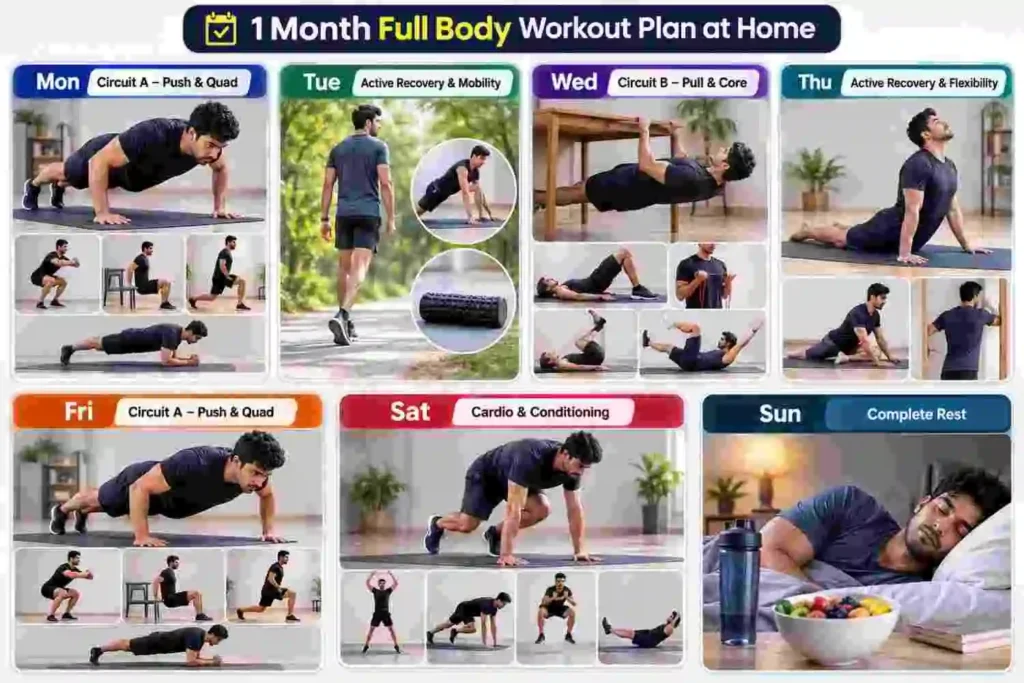
What Is a 1 Month Full Body Workout Plan at Home?
A 1 month full body workout plan at home is a structured 30-day fitness program designed to target every major muscle group—chest, back, shoulders, arms, legs, and core—in a single session using bodyweight exercises or minimal home equipment. This approach maximizes caloric expenditure, optimizes muscle protein synthesis, and eliminates the need for a traditional home gym setup.
Weekly Workout Schedule: Day-by-Day Execution
(1). Monday: Total Body Circuit A (Push & Quad Dominant)
Perform 5 minutes of dynamic stretching before your workout. Complete 4 rounds of the circuit, resting for 60 seconds between each round. Finish with 5 minutes of post-workout cool-down stretches.
- Chest workout: Standard Push-Ups (10–15 reps)
- Squat exercises & Quads exercises: Bodyweight Air Squats (15–20 reps)
- Upper body workouts: Chair/Bench Dips (12–15 reps)
- Glute exercises: Walking Lunges (12 reps per leg)
- Plank exercises: High Plank to Low Plank (45 seconds)
(2). Tuesday: Active Recovery & Mobility
Focus on injury prevention, flexibility training, and muscle recovery techniques to support recovery and reduce muscle fatigue without placing excessive stress on the central nervous system.
- Light Cardio: 20–30 minute brisk walk or light cycling.
Mobility Work: 10–15 minutes of dynamic stretching and foam rolling.
(3). Wednesday: Total Body Circuit B (Pull, Posterior Chain & Core)
Perform pre-workout dynamic stretching (5 mins). Complete 4 rounds of the circuit with 60 seconds rest between rounds. Finish with post-workout cool-down stretches (5 mins).
- Upper body workouts: Inverted Rows under a sturdy table OR Towel Door Lat Pulldowns (12–15 reps)
- Glute exercises & Posterior Chain: Single-Leg Glute Bridges (12 reps per leg)
- Bicep exercises: Bodyweight Doorframe Curls or Resistance Band Curls (15 reps)
- Core strength training: Reverse Crunches (15 reps)
Abs workout: Deadbugs (10 reps per side, controlled tempo)
(4). Thursday: Active Recovery & Flexibility Training
Keep blood flowing through low-intensity movement to support muscle repair.
- Active Walk: 30 minutes of light outdoor walking.
Stretching Routines: Perform Cobra Stretch, Pigeon Pose, and Doorway Chest Stretch for 2 rounds (hold each for 60 seconds).
(5). Friday: Total Body Circuit A (Push & Quad Dominant)
Start with 5 minutes of dynamic stretching to warm up. Complete 4 rounds of the circuit, resting for 60 seconds between each round. Finish with 5 minutes of cool-down stretches after the workout.
- Chest workout: Standard Push-Ups (10–15 reps)
- Squat exercises & Quads exercises: Bodyweight Air Squats (15–20 reps)
- Upper body workouts: Chair/Bench Dips (12–15 reps)
- Glute exercises: Walking Lunges (12 reps per leg)
- Plank exercises: High Plank to Low Plank (45 seconds)
(6). Saturday: Cardio & Conditioning
Perform pre-workout dynamic stretching (5 mins). Complete 3 full rounds (45 seconds work, 15 seconds rest per movement). Finish with post-workout cool-down stretches (5 mins).
- Burpees: Explode off the floor, engaging full-body power (45s work / 15s rest).
- Jumping jacks: Maintain a steady rhythm for active aerobic recovery (45s work / 15s rest).
- Mountain Climbers: Keep your core locked to build core strength (45s work / 15s rest).
- Bodyweight Jump Squats: Focus on soft landings to protect joints (45s work / 15s rest).
- Hollow Body Hold: Maintain lower back contact with the floor (45s work / 15s rest).
(7). Sunday: Complete Rest & Recovery
No structured physical exertion. Prioritize protein intake, hydration, and 8+ hours of sleep to prepare for the upcoming training week.
Warm-Up, Mobility, and Cool-Down Protocols
(1). Dynamic Stretching
Begin each training session with 5 minutes of dynamic stretching to prepare your muscles and joints for movement.
- Arm Circles & Hugs: 30 seconds each direction (shoulder joint lubrication).
- World’s Greatest Stretch: 5 reps per side (thoracic mobility and hip opener).
Leg Swings: 10 forward/backward reps per leg (hamstring dynamic activation).
(2). Flexibility Training & Cool Down
- Cobra Stretch: 45 seconds (abdominal wall relief).
- Pigeon Pose: 60 seconds per side (glute and piriformis tension release).
- Doorway Chest Stretch: 45 seconds per side (pectoral lengthening).
How Does a Home Full Body Workout Build Muscle and Burn Fat?
Full body workouts engage large muscle groups simultaneously through compound movements, creating a high metabolic demand that increases excess post-exercise oxygen consumption (EPOC). This elevated metabolic state forces the body to burn calories at a higher rate for up to 24 hours post-workout while driving mechanical tension for muscle hypertrophy.
In our testing across beginner workout plan deployments, multi-joint bodyweight exercises trigger systemic neuromuscular adaptations faster than isolated movements, making them superior gym alternatives for home environments.
Nutrition and Recovery for Maximum Results

Executing a 1 month full body workout plan at home yields optimal physical changes only when supported by adequate fuel and cellular repair.
- Nutrition for fitness: Maintain a slight caloric deficit (300–500 kcal) for fat loss or a slight surplus for muscle gain. Prioritize whole foods and systematic meal prep for fitness.
- Protein Intake: Target 1.6 to 2.2 grams of protein per kilogram of body mass daily to support muscle protein synthesis.
- If you want to accelerate results further, pair this training plan with the right stack — see our guide on the best supplement for muscle gain and strength.
- Post-workout nutrition: Consume a balance of fast-digesting protein and complex carbohydrates within 60 minutes post-session.
- Sleep & Recovery workouts: Aim for 7–9 hours of quality sleep nightly to optimize human growth hormone (HGH) release and neural recovery.
What Results Can You Expect in 30 Days?
Following a structured 30-day home fitness program yields measurable improvements in cardiovascular capacity, movement efficiency, muscular endurance, and body composition within a single month. While structural muscle growth varies based on training history and starting point, consistent execution delivers clear physical and performance benchmarks across a 4-week timeline.
(1). Days 1–7: Neuromuscular Adaptation and Conditioning
- What Happens: Your initial strength boost comes from your brain learning how to fire up your muscles more efficiently, not from rapid muscle growth. Muscle soreness typically peaks during this first week as your body adapts to new movements.
Expected Result: Better balance during plank exercises, smoother motion during squat exercises, and a noticeable boost in daily energy.
(2). Days 8–14: Boosting Heart Power and Stamina
- What Happens: Shorter rest breaks and cardio-focused circuits challenge your lungs and heart, teaching your body to burn energy more efficiently during bodyweight exercises.
Expected Result: Catching your breath faster between circuits, feeling less tired during burpees and jumping jacks, and experiencing far less post-workout soreness.
(3). Days 15–21: Building Endurance and Muscle Tone
- What Happens: Increasing your workout reps and slowing down your movements pushes your muscles to store more hydration and energy, helping them work harder for longer without burning out.
Expected Result: Visible muscle definition in your shoulders, legs, and core, plus the ability to finish push-ups and inverted rows without breaking form.
(4). Days 22–30: Fat Loss and Overall Body Transformation
- What Happens: Higher calorie burning during workouts—combined with a clean, balanced diet—helps your body shed excess fat while preserving your hard-earned muscle.
Expected Result: A slimmer waistline, higher daily stamina, and the power to sail through all rounds of Circuit A and Circuit B with ease.
Exercise Modifications for Different Fitness Levels
Adapting exercise difficulty allows individuals of varying fitness levels to maintain proper intensity while preventing dynamic form breakdowns.
| Base Exercise | Beginner Option (Regression) | Advanced Option (Progression) |
|---|---|---|
| Standard Push-Ups | Incline Push-Ups (hands on a table or couch) | Decline Push-Ups (feet elevated on a chair) |
| Bodyweight Air Squats | Box Squats (squat down to a chair) | Jump Squats / Bulgarian Split Squats |
| Inverted Rows | Resistance Band Lat Pulldowns | Single-Arm Inverted Rows / Deficit Rows |
| Walking Lunges | Stationary Reverse Lunges | Deficit Reverse Lunges / Jumping Lunges |
| High-to-Low Plank | Static Forearm Kneeling Plank | Dynamic Plank with Alternating Shoulder Taps |
Common Mistakes in a Home Workout Plan
The most common mistakes in a 30-day home fitness program include skipping progressive overload, neglecting proper movement mechanics, bypassing warm-up routines, and under-recovering between sessions. Avoiding these critical pitfalls ensures continuous muscle adaptation, prevents plateaus, and reduces overall injury risk during zero equipment workouts.
Top Execution Mistakes and Solutions
(1). Ignoring Progressive Overload in Your Routine
- The Mistake: Performing the exact same reps, sets, and tempo every week without increasing difficulty.
The Fix: Systematically increase workout intensity each week by adding repetitions, decreasing rest intervals, or slowing down the eccentric (lowering) phase of bodyweight exercises.
(2). Sacrificing Form for Higher Rep Counts
- The Mistake: Rushing through reps with poor kinetic alignment (e.g., sagging hips during push-ups or caving knees in squat exercises) to complete a circuit faster.
The Fix: Prioritize full range of motion and core strength training control over pure rep numbers to ensure safety and maximum muscle stimulation throughout the month.
(3). Bypassing Dynamic Warm-Ups and Cool-Downs
- The Mistake: Jumping straight into high-intensity circuits cold, leading to joint strain and reduced power output.
The Fix: Spend 5 minutes on dynamic stretching before starting your session and 5 minutes on static flexibility training after finishing to protect joints and improve mobility.
(4). Neglecting Posterior Chain Exercises
- The Mistake: Over-emphasizing push movements (push-ups, dips) while neglecting pull movements (inverted rows, glute bridges), creating muscular imbalances.
The Fix: Maintain a strict balance between pushing and pulling mechanics across your weekly workout schedule to support posture and overall shoulder integrity.
(5). Underestimating Nutrition and Sleep Needs
- The Mistake: Expecting maximum transformation while staying in an unmonitored caloric deficit or sleeping under 7 hours a night.
The Fix: Pair your daily workout routine with targeted nutrition for fitness, adequate daily protein intake, and consistent sleep to allow effective muscle recovery techniques to occur.
Conclusion
Completing a 1 month full body workout plan at home successfully requires balancing progressive exercise overload with systematic muscle recovery. By consistently targeting all major muscle groups through bodyweight exercises, maintaining precise movement control, and adhering to high-protein nutrition for fitness, individuals achieve long-term physical strength and functional endurance without relying on commercial gym equipment.
Frequently Asked Questions
- Can you build muscle with a 1 month full body workout plan at home without equipment?Yes. By leveraging progressive overload techniques—such as increasing time under tension, slowing down eccentrics, shortening rest periods, or performing harder movement variations—you continuously challenge muscle fibers to drive hypertrophy.
- How many days a week should I do a full body home workout?Four days a week is the sweet spot for home workouts. This split gives your muscles enough work to grow while leaving three rest days for your body to repair and recover safely.
- What should I do if an exercise is too hard for me?Easily swap it for an easier version. If regular push-ups are too hard, do incline push-ups against a wall or couch. If lunges feel unstable, try static split squats while holding onto a chair for balance.
- How do I keep getting results after finishing the 30-day plan?Keep challenging your body so you don't hit a plateau. You can move to harder bodyweight moves, add inexpensive resistance bands, or pick up a set of dumbbells to keep building strength.
Author: I’m Nikhil, the founder of FitNova360. I’ve completed professional nutrition certification courses through Coursera and have a strong interest in nutrition, fitness, and healthy living. I’m committed to sharing clear, evidence-based information that makes complex health and fitness topics easier to understand and apply. My goal is to help readers make informed decisions and develop practical, sustainable habits for a healthier lifestyle.