For many years, scientists believed the brain stored personal life memories (like your birthday or a trip) and facts (like knowing the Sun is a star) in two different systems. But new brain scan research shows something surprising. When people remember a personal moment and when they remember a simple fact, almost the same parts of the brain become active. This suggests the brain may use one shared memory system instead of two separate ones.
This discovery is important because in conditions like Alzheimer’s disease and dementia, damage to this shared system could affect both life memories and general knowledge at the same time. Scientists now think future treatments might focus on protecting this single memory network to help people keep their memories longer.
Source:
This information is supported and reported by trusted sources including ScienceDaily, the University of Nottingham, Neuroscience News,Nature of behaviour and The Debrief. Together, they highlight new brain imaging research showing that facts and life memories may rely on the same brain networks. The aim is to make brain science easy to understand and help readers learn how memory really works.
The Study That Changed the Memory Rulebook
The researchers from the University of Nottingham and the University of Cambridge collaborated to answer an important question: Does the brain employ different regions to recall life experiences and facts? For over 40 years, the answer to this question was yes.But in this study, both types of memory were tested in very similar ways for the first time.The findings were published in the journal Nature Human Behaviour, and they challenge what has been believed for over 40 years.
To explain this, it is helpful to know about the two types of memory. The first is episodic memory, which is memory about your life. This would be things such as your last birthday, your first day of college, or a vacation that you enjoyed. These memories are linked to a time and a place. Some scientists refer to this as “mental time travel” because you feel as though you are traveling back in time.
The second type is semantic memory, which is memory for facts and general knowledge. This includes knowing that Delhi is the capital of India, water boils at 100°C, or that Nike is a sports brand. These memories are not connected to a specific moment in your life. You usually don’t remember when you first learned them.
For a long time, it was believed that episodic and semantic memories were located in different parts of the brain. However, this new study indicates that they may use the same parts of the brain. This means that the brain does not distinguish between life memories and facts as much as we thought.
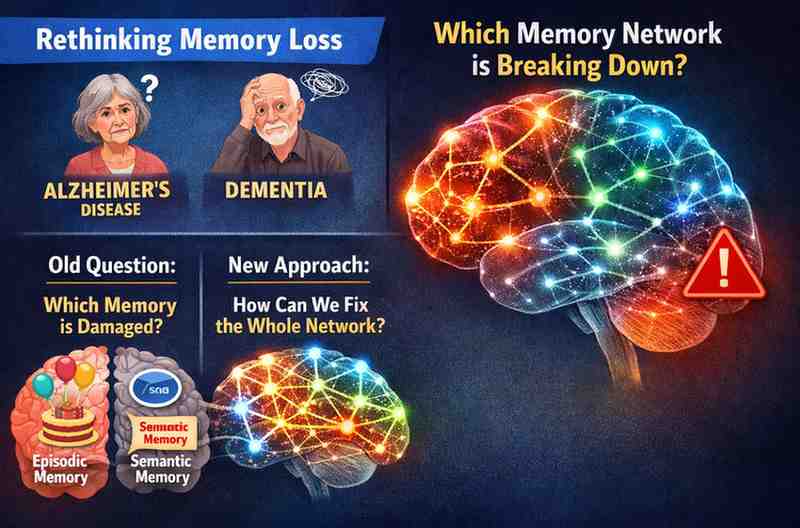
Brain scans showed this was true.
To ensure that the test was fair for both kinds of memories, the scientists asked people to do almost the same kind of memory work. They showed them different logos and names of products. Some logos belonged to real brands that the people already knew, while others belonged to new brands that the people had learned about only recently in this study. Although one was about old knowledge and the other was about a recent event, the brain scans showed that both used the same memory system. While people were working on remembering the names and logos, scientists used an fMRI machine to scan their brains.
What is FMRI Test?
fMRI, which stands for functional Magnetic Resonance Imaging, is a type of brain scan that shows which parts of the brain are working. When a part of your brain works harder, it needs more oxygen, so more blood flows to that area. The fMRI machine can detect these small changes in blood flow and turn them into images.
This helps scientists see which areas of the brain are active while a person is doing something, like thinking, feeling, or remembering. It is almost like watching the brain light up while it works.
The Shocking Result
The researchers thought they would see clear differences between the two types of memory. But that did not happen. Instead, both life memories and fact memories used almost the same brain areas. The lead researcher, Roni Tibon, said they were truly surprised. Based on many years of past research, they expected the brain scans to show two separate memory systems. But the difference was very small. This suggests that the brain may not separate memories into clean groups, the way textbooks usually explain it.
Does the brain really not separate memories the way we believed?
Exactly. The brain may not have two completely different memory systems. Rather, memory could be like a team, where the same parts of the brain work together when you attempt to remember something. Your brain may not care much about whether you are remembering a birthday from childhood or the name of a famous brand. In both cases, it may use one main memory system and only make small adjustments depending on what you are remembering.
Why This Matters for Alzheimer’s and Dementia ?
This discovery could change how scientists think about memory loss. Illnesses like Alzheimer’s disease and dementia affect different kinds of memory, but if those memories all use the same brain system, treatments may need to protect a bigger brain network instead of just one small area. In the past, researchers asked, “Which type of memory is damaged?” Now they may start asking, “Which shared memory system in the brain is not working properly?” This is a big change in how scientists understand memory and brain disease.
Conclusion:
This discovery shows our brain may use the same system to remember facts and life events. Memory isn’t separated like we thought — it’s more connected, and this could change how scientists understand memory and brain diseases.