- Sources: PubMed Central (PMC), Sleep Research Society .
The best time for sleeping for most students is between 10 PM and 11 PM, as our body clock begins to produce hormones for sleeping at this time and it also helps us get 7-9 hours of sound sleep.Knowing the right bedtime is just the first step. If you often stay awake in bed for a long time, you may also need to learn how to fall asleep faster using simple breathing and relaxation techniques.
The best time for sleeping is not the same for all. Teenagers, college-going students, adults, and elderly people require slightly different times for sleeping and hours of sleep as per their age and body requirements.
Have you ever stayed awake at 2 AM, looking at the ceiling and thinking, “Am I a night owl… or did I just watch one more Netflix episode?” 😅
It happens to all of us. The internet gives many tips on how to live with less sleep and more coffee, but the truth is easy—our body is not a switch. It has its own natural clock, and it needs good sleep at the right time to stay healthy.
Sleeping at the right time is not only about dark circles. It helps your mind think clearly, muscles heal faster, hormones stay normal, and your energy stay high—which is very important for students .
Best time to sleep at night
The best time to sleep varies according to age, but the body clock works best when we sleep early.
- Young Teenagers (13–17 years): Young teens should aim to sleep between 9 PM to 10 PM and have 8-10 hours of sleep. Since their brain and body are still developing, sleeping early will help them have a good memory, a good mood, and will also help them grow to the correct height. If they sleep late, they might feel tired in school and will also be more stressed.
- Students & College Age (18–25 years):This is especially critical for students who sacrifice sleep for study sessions. Many students wonder whether 4 hours of sleep is enough to function well academically — the science says it is not, and the consequences are serious. College-going students need to sleep between 10 PM and 11 PM and for 7-9 hours. This is because sleeping at this time and for this duration helps in focusing on studies, performing well in exams, recovering from the gym quickly, and maintaining energy levels throughout the day.
- Adults (26–60 years): The adults should also try to sleep between 10 PM and 11 PM with 7-8 hours of sleep. Sleeping on time helps maintain a healthy heart, manages stress, regulates hormones, and enhances work performance. Sleeping irregularly can lead to tiredness, gaining weight, and mood swings.
- Older Adults (60+ years): Elderly people should sleep a little earlier, around 9 PM to 10:30 PM, and get 6-8 hours of sleep. Sleeping well can keep the memory sharp, immunity strong, and energy levels high. Short naps in the day are okay, but long naps can disturb night sleep.
The Science of Your Internal Clock: Chronobiology 101
In your brain, there is a very small part called the sleep clock (scientists call it the suprachiasmatic nucleus). You can think of it like a boss of your body’s timing. It watches the light around you and tells your body when to wake up and when to sleep.
This daily 24-hour cycle is called your body clock or circadian rhythm. It doesn’t only control sleep. It also controls when you feel hungry, how active you feel, and even your body temperature. When it gets dark in the evening, your brain makes a sleep hormone called melatonin, which helps you feel sleepy and ready for bed.
But if you stay awake late with bright lights and phone screens, you confuse your body clock. Phone blue light looks like daytime to your brain, so it stops making melatonin. That’s why you don’t feel sleepy even when it’s late.
Why Timing Matters: The Physiological Payoff
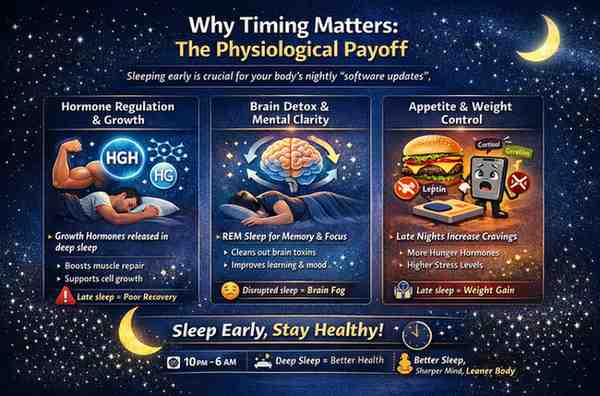
Sleeping at the “right” time is not just a recommendation; it is a biological need for maintenance. Your body does certain “software updates” at different points in the night.
(1). Hormone Regulation and Growth
One of the most important reasons why you should sleep early is the secretion of growth hormones. Growth hormones are mainly secreted during the slow-wave sleep phase, which is more prevalent in the first six hours of your sleep. If you are going to bed at 3:00 AM every day, you may be cutting your growth and repair phase, even if you are sleeping for eight hours. This may result in lower physical recovery and, in shift workers, has been shown to increase the risk of insulin resistance.
(2).Cognitive Function and Mental Clarity
Your brain literally needs a “brain wash” to remove metabolic waste through sleep. Synchronizing your sleep patterns with your circadian rhythm will help you get adequate REM sleep, which is essential for memory and emotional processing. Studies have found that when sleep patterns are desynchronized, functions such as attention and problem-solving are severely affected.
(3).Appetite and Weight Management
Have you ever noticed that you are craving a greasy burger after a late night? This is not a lack of willpower; it is biology. When you stay up late, your body produces more cortisol (the stress hormone) and ghrelin (the hunger hormone) and less leptin (the “I’m full” hormone). In other words, when you stay up late, your body is like a hungry, stressed-out machine that can’t tell when it’s had enough.
Consistently missing your sleep window doesn’t just leave you tired — it has serious downstream effects on your health. Research confirms that chronic insomnia and anxiety can significantly weaken your immune system, making you more susceptible to illness.
How to find my chronotype?
Although the “10:00 PM to 6:00 AM” schedule is the gold standard for many, humans are not one-size-fits-all. Your “chronotype” is your genetic predisposition to be active at certain times of the day.
- Morning Larks: These individuals are early risers and feel most productive during the morning hours. Their midpoint of sleep is typically before 3:30 AM. Larks usually claim that they feel more refreshed and find it easier to follow a conventional 9-to-5 schedule.
- Night Owls: People like this feel more active at night and find it really hard to wake up early, because they sleep late and the middle of their sleep happens after 5:30 in the morning. Being a “night owl” is normal and just how their body clock works, but it can cause social jet lag, which means feeling tired and low on energy because their natural sleep time doesn’t match school, college, or work schedules.
- Third Birds (or Hummingbirds): Most people are in the middle group when it comes to sleep. They are not very early risers, and they are not big night owls either. They can wake up early if needed, or stay up a little late sometimes, without too much trouble. With a small effort—like fixing a sleep time, reducing phone use at night, and waking up at the same time every day—they can easily adjust their routine. This type of sleep pattern is common for students and working people because their schedule changes for exams, classes, or work. But even if you can adjust, it’s still best to keep a regular sleep time so your body stays healthy, your mind stays sharp, and your energy stays high for studies and gym.
Tips for better sleep schedule
- Prioritize Morning Light: To “reset” your body clock, go outside and get at least 15 minutes of sunlight as soon as you wake up. This will tell your brain that it is now the beginning of the day and will help your body get sleepy at the right time of night.
- The 10:00 PM Rule: The goal is to be in bed by 10:00 PM to maximize the release of growth hormones during the first half of your sleep cycle.
- Digital Sunset: Your pre-sleep habits matter just as much as the time you go to bed. Start by turning off devices that emit blue light 60 minutes before bedtime, as blue light confuses your brain into thinking it’s still daytime and reduces melatonin production. If you must use devices, switch to warm filters to reduce SCN disruption. You can also try drinking warm milk before bed, which has been shown to further support melatonin production and help you wind down faster.
- Consistency is King: Go to bed and wake up at the same time every day—yes, even on weekends. This helps create “sleep pressure” so that sleeping is easier.
- Listen to Your Body: If your body prefers late nights, don’t try to wake up super early just because others say it’s good. Pick a wake-up time you can follow every day.
Best exercises for sleep
These sleep methods are easy but very effective. Practice cognitive shuffling by choosing a letter and thinking of random words with small pictures in your mind to distract your brain. Perform slow breathing by taking 5 seconds to breathe in and 5 seconds to breathe out for a few minutes to calm your body. Practice the military shutdown technique by relaxing your facial muscles, shoulders, arms, chest, and legs one by one and picturing a peaceful scene. The physiological sigh—a deep breath, a slight extra breath, and a long exhale—quickly relieves stress, and reverse blinking (close your eyes for 2 seconds, then open for 1 second) imitates sleepy eye movement and prepares your brain for sleep.
Conclusion:
The best sleeping schedule is when you can get 7-9 hours of sleep and go to bed at the same time every day in a way that matches with your body clock and the day-night cycle. This means sleeping before midnight so that your body can get the important repair work done in the early part of the night. Although modern life with bright lights and busy schedules makes us feel like sleep is not important, our body knows that sleep is important. When you sleep at the same time that your body wants you to, you are not just sleeping; you are also making your brain work better, regulating your hormones, and keeping your body strong and healthy.
FAQ
- what is the 5-3-3 rule for babies?The 5-3-3 rule for a baby refers to a way of understanding the sleeping patterns of a baby at night. It means that the baby sleeps in three stretches, 5 hours, 3 hours, and another 3 hours before the morning comes. This is due to the fact that the baby has a small stomach, which requires the baby to wake up to feed, change diapers, etc.
- What is the unhealthiest sleeping position?The unhealthiest sleep position for most people is sleeping on your stomach. This sleep position will cause your neck to twist sideways for a long time, and it may cause pain in your neck and shoulder areas.
- What is the 321 rule before bed?The 3-2-1 rule simply means no heavy food 3 hours before sleeping, no study or work 2 hours before sleeping, and no phone or laptop 1 hour before sleeping.
- Why am i waking up 3 hours after i fall asleep?Nike, waking up around 3 hours after sleep usually happens because, at this time, the sleep cycle becomes lighter, which means that stress, too much coffee before sleeping, too much food before sleeping, or using the phone before sleeping can wake you up. You can try the 3-2-1 rule to fix this issue.
- Is 6 hours sleep a night ok?Nike, 6 hours of sleep is not enough most of the time for young adults. It is recommended to have 7 to 9 hours of sleep to be more focused on your studies and to have enough rest from your workouts.
- Does sleeping 12 hours good?Sleeping 12 hours once in a while is good, but sleeping 12 hours regularly is not good. Most students and people who go to the gym need 7 to 9 hours of sleep.
- What is the healthiest hours of sleep?The healthiest amount of sleep for most students and young adults is 7-9 hours per night, ideally sleeping around 10-11 PM to 6-7 AM.
- is 7pm to 4am enough sleep?Sleeping from 7 PM to 4 AM is totally fine because it gives you about 9 hours of sleep.
- What foods help you sleep better?The food items which can help you sleep better include milk, almonds, bananas, walnuts, oats, yogurt and kiwi fruits.
- What drinks help you sleep better?The drinks that help in sleeping well are warm milk, chamomile tea, turmeric milk, almond milk, and cherry juice.
Pingback: Is 4 Hours of Sleep Enough for Students