Why Beginners Need Strength Training First
Strength training helps beginner runners by protecting weak joints, fixing muscle imbalances, and making running feel easier.Your cardiovascular system adapts much faster than your bones, tendons, and muscles, and every foot strike sends 2 to 3 times your body weight through your legs.
Protects Weak Joints: Builds support around your knees, hips, and ankles to stop pain before it starts.
Fixes Muscle Imbalances: Running only moves your body forward. Strength exercises train your muscles to move in all directions, keeping your pelvis level.
Makes Running Feel Easier: Stronger legs push off the ground with less effort, making your normal running pace feel more relaxed.
Beginner Strength Training Exercises
This beginner’s guide to strength training for runners uses 7 simple exercises designed specifically for first-time runners.
1. The Wall Sit
The wall sit is an isometric exercise where you hold a seated position against a wall with your knees at 90 degrees, building endurance in your quads, glutes, and hips without any impact on your joints.
How to do it: Stand with your back against a wall. Slide down until your knees are bent at a comfortable angle (aiming for 90 degrees as you get stronger). Keep your back flat against the wall.
Goal: Hold for 20 to 30 seconds. Repeat 3 times.
2. Glute Bridges
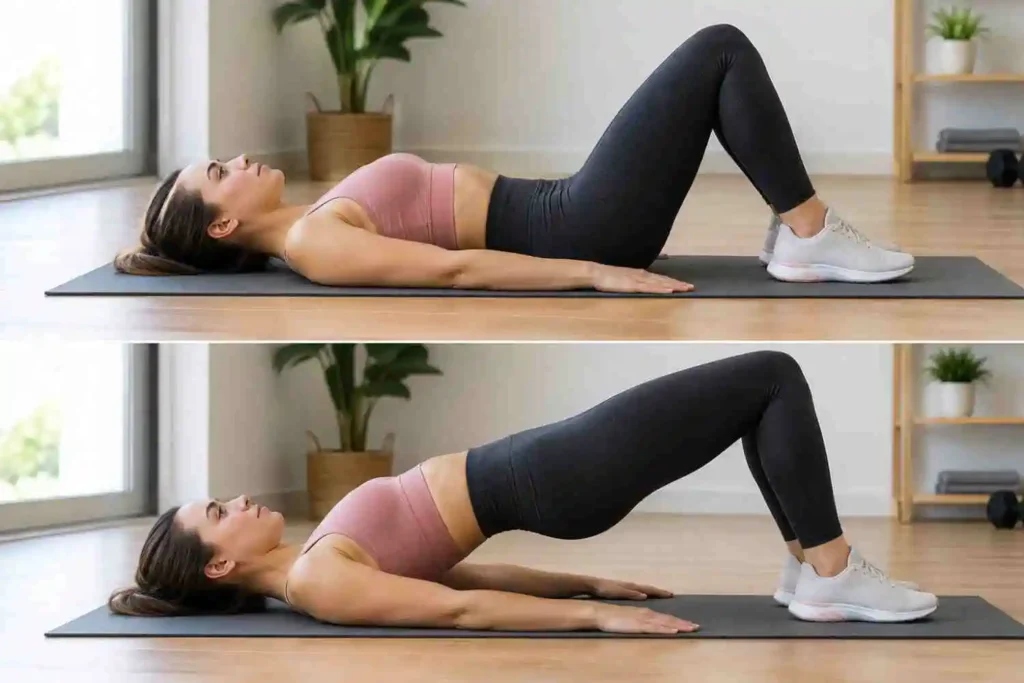
A glute bridge is a floor exercise where you lie on your back with knees bent and lift your hips toward the ceiling, strengthening your glutes and hamstrings while keeping your pelvis stable for running.
How to do it: Lie on your back with your knees bent and feet flat on the floor. Squeeze your buttocks and lift your hips until your body forms a straight line from your shoulders to your knees. Hold for 2 seconds at the top, then lower slowly.
Goal: 10 to 12 reps. Repeat 2 to 3 times.
3. Step-Ups
A step-up is a single-leg exercise where you press through one foot to lift your body onto a box or bench, strengthening your quads, glutes, and hips while training the one-leg balance running demands.
How to do it: Stand in front of a sturdy step or box. Place your right foot fully on the step, press through your heel, and lift your body up until your right leg is straight. Step back down carefully and repeat on the other side.
Goal: 8 to 10 reps per leg. Repeat 2 to 3 times.
4. Standing Calf Raises
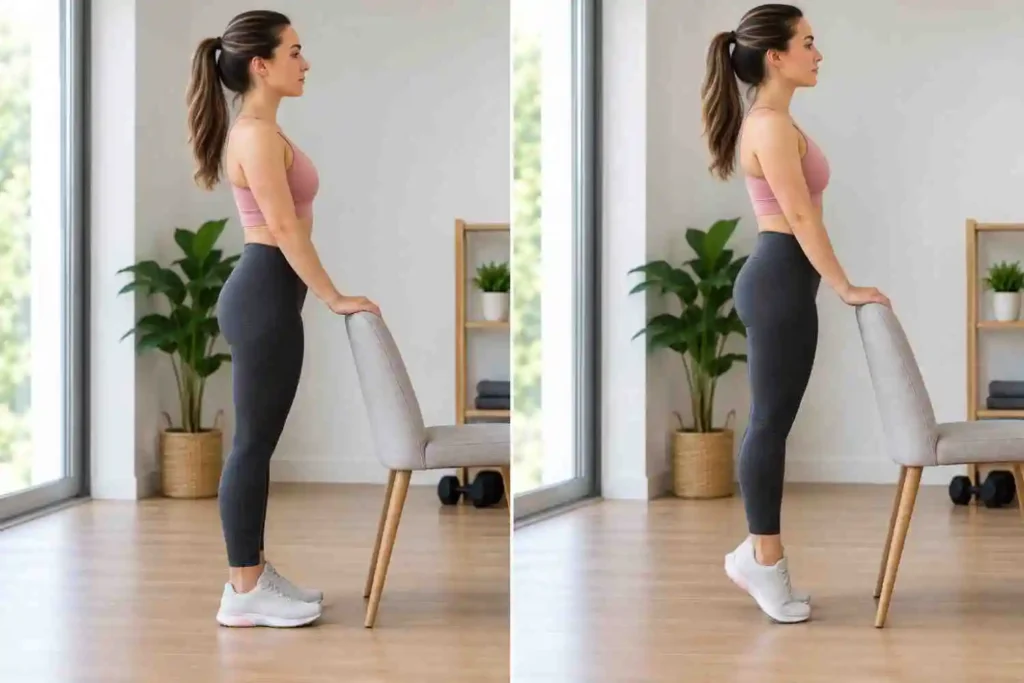
A standing calf raise is an exercise where you rise onto the balls of your feet and lower back down slowly, strengthening your calves and Achilles tendons, which absorb and return force with every step.
How to do it: Stand tall near a wall or chair for balance. Slowly raise up onto the balls of your feet as high as you can. Pause for a second at the top, then slowly lower your heels back to the floor.
Goal: 12 to 15 reps. Repeat 3 times.
5. Standard Knee Plank
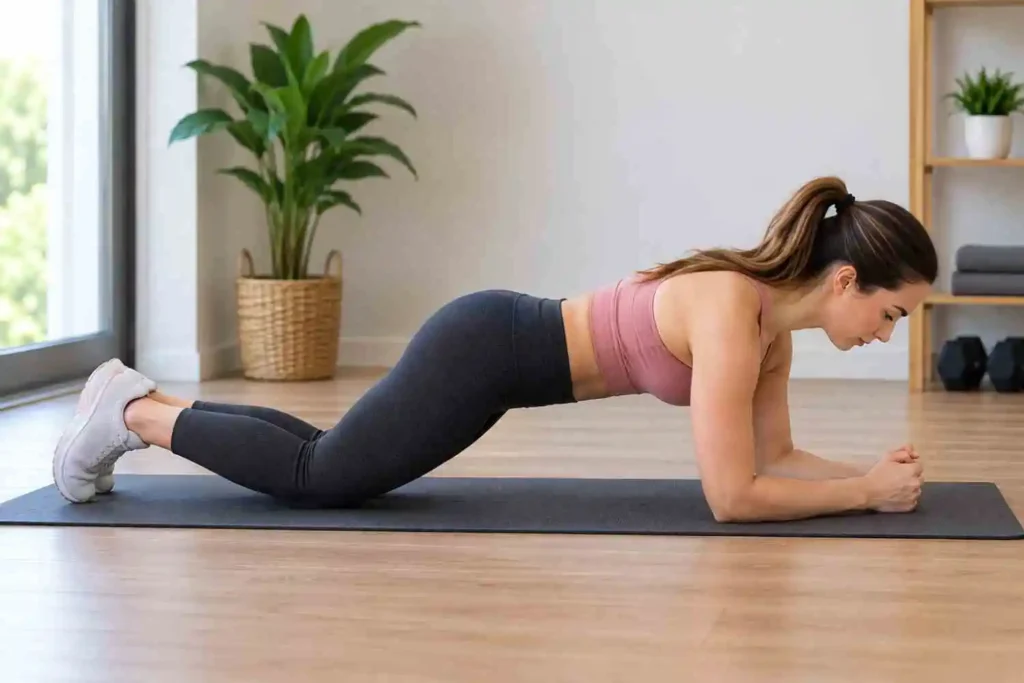
A standard knee plank is a core exercise where you hold your body in a straight line from head to knees, resting on your forearms and knees, strengthening your abs, back, and shoulders while keeping your pelvis stable.
How to do it: Rest on your forearms and knees. Keep your body in a straight line from your head to your knees, pulling your belly button toward your spine. Do not let your lower back sag.
Goal: Hold for 20 to 30 seconds. Repeat 3 times.
6. Bodyweight Squats
A bodyweight squat is a lower-body exercise where you lower your hips back and down as if sitting into a chair, then stand back up, strengthening your quads, glutes, and hamstrings without any equipment.
How to do it: Stand with your feet shoulder-width apart, toes pointing slightly outward. Push your hips back and bend your knees as if sitting down into an imaginary chair, keeping your chest up. Lower until your thighs are parallel to the floor, then press through your feet to stand back up.
Goal: 10 to 12 reps. Repeat 2 to 3 times.
7. Reverse Lunges
A reverse lunge is a single-leg exercise where you step one foot backward and lower your hips until both knees bend to about 90 degrees, then push back up, strengthening your quads, glutes, and hamstrings while training balance.
How to do it: Stand tall with your feet hip-width apart. Take a step backward with your right leg and lower your hips straight down until both knees form 90-degree angles. Press through your front heel to step back up to the starting position, then switch legs.
Goal: 8 to 10 reps per leg. Repeat 2 to 3 times.
Weekly Schedule for Complete Beginners
| Day | Activity | Focus |
|---|---|---|
| Monday | Rest Day | Full body recovery |
| Tuesday | Run / Walk + Strength | Run first, then 20 to 30 minutes of strength exercises |
| Wednesday | Rest Day or Easy Walk | Light movement to clear stiffness |
| Thursday | Run / Walk | Focus purely on comfortable running pace |
| Friday | Rest Day or Easy Walk | Recovery |
| Saturday | Run / Walk + Strength | Run first, then 20 to 30 minutes of strength exercises |
| Sunday | Rest Day | Full body recovery |
4-Week Strength Training Progression Plan
Week 1–2: Foundation Phase
- Frequency: 2 sessions per week
- Format: Bodyweight only
- Workout: The beginner routine above (wall sit, glute bridges, step-ups, calf raises, plank, squats, reverse lunges)
- Sets & Reps: 2 to 3 sets of 10 reps (or 20-second holds for wall sit and plank)
- Focus: Learning proper form
Week 3–4: Building Phase
Frequency: 2 sessions per week
Format: Bodyweight + light resistance bands
Workout: Same 7 exercises + introduce Side Planks & Dead Bugs for extra core stability
Sets & Reps: 3 sets of 10–12 reps (focusing on controlled tension)
Focus: Increasing volume while preserving perfect movement patterns
Week 5 onward: Progressing Phase
- Frequency: 2–3 sessions per week
- Format: Add light dumbbells (2–5 kg) or increased band tension
- Workout: Same foundation exercises or single-leg variations
- Sets & Reps: 3 sets of 8–10 reps (lowering reps as load increases to build strength)
- Focus: Progressive overload—gradually adding small weight increments over time
The 4 Simple Rules for Beginner Runners
If you’re new to strength training, begin with simple bodyweight exercises, aim for two strength sessions per week, perform them after your run, and use controlled movements to build strength and proper form.
Start with Bodyweight Only: You can build foundational strength at home using just your body weight and basic items (like a stair step).
Train 2 Days a Week: Keep your strength days spaced out (like Tuesday and Saturday). Never strength train on consecutive days when starting out.
Do It After Your Run: Always complete your run or walk-run session first. Do your strength exercises right after, while your muscles are already warm.
Focus on Slow, Controlled Movements: Never rush through reps. Count 2 seconds on the way down and 2 seconds on the way up to learn good form.
Beginner Strength Training Safety Tips for Runners
- Warm up first — Never strength train on cold muscles.
- Prioritize form over reps — Bad technique leads to injury, not gains.
- Listen to your body — Sharp pain (not muscle fatigue) means stop immediately.
- Don’t skip rest days — Muscles grow and repair during recovery, not during the workout.
How Often Should Runners Strength Train?
- 2-3 sessions per week is the sweet spot for most runners.
- 20-30 minutes per session is enough — duration doesn’t need to be long.
- Rest at least one day between strength sessions to allow muscle recovery.
- Avoid heavy leg days right before hard running workouts or races.
How Should Runners Warm Up and Cool Down?
Warm-Up Routine (5-10 minutes)
- Dynamic stretching — Leg swings, walking lunges, high knees.
- Light cardio — A brisk 3-5 minute walk or jog to raise heart rate.
Cool-Down Exercises (5-10 minutes)
- Static stretching — Hold each stretch for 20-30 seconds.
- Foam rolling techniques — Roll quads, hamstrings, and calves to release tension.
- Deep breathing — Helps lower heart rate and signals recovery to your body.
Common Mistakes Beginner Runners Make with Strength Training
1. Doing too much too soon
Start with bodyweight exercises and low volume. Do not add weight until you can perform each exercise with perfect form. Be careful not to overload your muscles.
2. Using the wrong rep range
For beginners, start with 10 to 12 reps using bodyweight to master form and joint stability. As you progress to adding external weight (Week 5 onward), shift to a 8 to 10 rep range with moderate resistance to build maximal strength and power without adding excess muscle bulk.
3. Not being consistent
Strength training works best when followed for several weeks because the body needs time to adapt. Consistency matters more than perfection.
4. Neglecting core stability and full-body posture
Running is a full-body activity. While lower-body exercises build your leg drive, neglecting your core and upper-body posture is a common mistake. A weak core causes energy leak and poor running form when fatigue sets in. Ensure your routine includes core stabilization (like planks and dead bugs) to keep your trunk upright and support a strong arm swing as your mileage increases.
Core Strength Exercises
The plank, side plank, and dead bug are the three core exercises runners and endurance athletes need most, because they stabilize the spine, improve posture, and keep running form efficient.
- Plank — Holds your spine stable and improves posture during long runs.
- Side plank — Strengthens obliques, which stabilize your hips while running.
- Dead bug — Builds deep core control without straining your lower back.
Conclusion
This beginner’s guide to strength training for runners comes down to two 20-to-30-minute bodyweight sessions a week, done right after your run. Starting with foundational exercises—wall sits, glute bridges, step-ups, standing calf raises, standard knee planks, bodyweight squats, and reverse lunges—helps protect your joints and build single-leg stability without any equipment. As you gain strength, you can introduce core additions like side planks or dead bugs and add light resistance starting in week 3.
frequently Asked Questions
- What is the best schedule for beginner strength training for runners?You should aim for 2 days per week on non-consecutive or easy running days.
- What strength exercises should beginner runners start with?Beginner runners should start with bodyweight squats, wall sits, glute bridges, step-ups, standing calf raises, standard knee planks, and reverse lunges to build core, glute, and lower-body strength safely.
- What's the best weekly schedule for strength training and running for a beginner?The best weekly schedule pairs 3 run days with 2 full-body strength days, giving you 2 complete rest days for muscle and joint recovery.
- How often should new runners lift weights?New runners should lift weights 2 days per week on non-consecutive or easy running days, allowing at least 48 hours of recovery between sessions to let muscles adapt and prevent overuse injuries.
- Strength training vs just running for beginners: what's better?Combining both is best because running builds cardiovascular endurance, while strength training builds the muscle balance, core stability, and joint strength needed to prevent injuries and run efficiently.
Disclaimer: The information provided in this guide is for educational and informational purposes only and should not be construed as medical advice. Always consult with a qualified healthcare professional or physician before starting any new exercise program, especially if you have pre-existing health conditions or injuries.
Author: Nikhil Kumar
Nutrition & Fitness Writer | Health Enthusiast
Nikhil Kumar is a Nutrition & Fitness Writer passionate about making evidence-based wellness simple and actionable. After completing a nutrition certification via Coursera, he continuously follows the latest research on food, movement, and longevity. His mission is to provide trustworthy, practical guidance that helps readers achieve their health goals confidently.
Source&References
A 26-week study on endurance athletes showed that progressive strength training significantly improves running efficiency.
According to NHS physical activity guidelines, doing strength and flexibility exercises at least 2 days a week helps build joint support and prevent injuries.
Research on runners shows that sticking to a consistent strength routine significantly reduces minor training injuries.
Pingback: Strength Training Plan for Runners: Exercises & Weekly Schedule
Pingback: Strength Training for Triathletes Without Bulking
Pingback: Home Strength Training for Triathletes: No Equipment Needed
Pingback: Strength Training for Endurance Athletes | Ultimate Guide
Pingback: Strength Training for Beginner Triathletes: Get Stronger Faster
Pingback: Basic Principles of Strength Training and Conditioning
Pingback: The 16-Week Strength Training Plan for Marathon Runners
Pingback: Strength Training for Cyclists at Home: The Complete Guide