Almond protein content per 28 grams: The Fitness Fuel You’re Missing

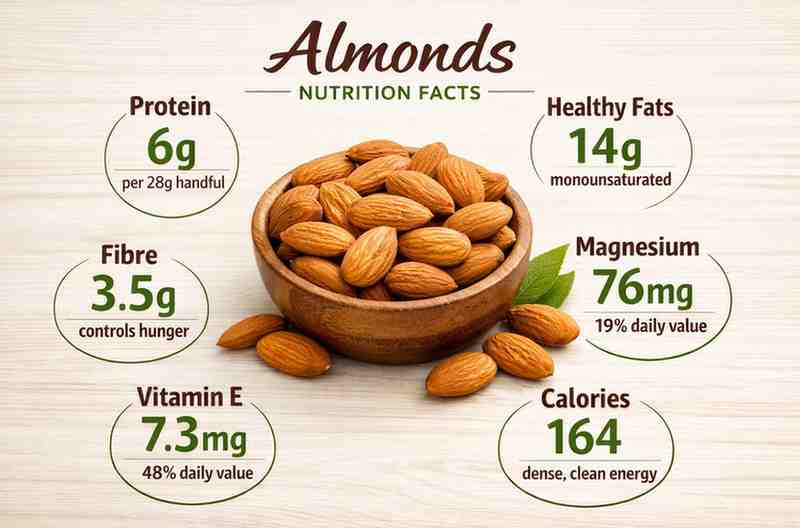
🔥 | Calories | 164 kcal | |
💪 | Protein | 6 g | |
🥑 | Total Fat | 14 g | |
🫒 | Saturated Fat | 1.1 g | |
🥦 | Fiber | 3.5 g | |
✨ | Vitamin E | 7.3 mg | |
⚡ | Magnesium | 76 mg |
Just one small handful. Six grams of protein. And then comes a secret of timing which very few people know, but it completely transforms your results.
Remember the last time you felt truly energised post-workout. Not just “fine” – but really recovered, sharp-minded, and ready for action tomorrow. For many, that moment is few and far between. And the typical answer? Eat more protein, pop more pills, sleep more.All true — but there’s something much simpler right in front of you.
A handful of 28 grams of almonds – about 23 almonds in a single handful – provides 6 grams of protein. If we consider 100 grams of almonds, the protein content rises to 21 grams of protein, making almonds equivalent to eggs, chicken, and Greek yoghurt in terms of protein content. The USDA FoodData Central database shows that the same handful of almonds comprises 14 grams of healthy fats, 3.5 grams of dietary fibre, 76 mg of magnesium, and 7.3 mg of Vitamin E, almost half of the daily recommended intake.
Nutritional value of almonds — and why each part matters for you
Let’s look at the full picture of what you’re getting, because the protein number alone undersells the almond entirely.
Arginine
The protein found in almonds is highly concentrated with arginine, which is an amino acid that your body uses to make nitric oxide. This helps to dilate blood vessels and ensures that more oxygen and nutrients are delivered to the muscles for growth. The feeling of muscle pumps, which most athletes experience when working out, is brought about by nitric oxide production. Almonds are a great source of arginine that you can eat regularly.
fat in almonds
It is understandable that when we hear “14 grams of fat,” we assume that it is going to lead to the development of body fat. However, this assumption comes from a history of being informed that fats are generally unhealthy. But the truth is, not all fats are the same. Different types of fat affect your body in different ways.
Of the 14 grams of fat in a handful of almonds, over 90 percent is unsaturated fat — specifically monounsaturated and polyunsaturated fat. This is the same category of fat found in olive oil and avocados, the foods nutritionists consistently recommend.
This kind of fat does not add to your body weight when taken in moderation. In fact, according to the European Journal of Clinical Nutrition, people who eat almonds regularly do not gain more weight than those who avoid them. The reason is the powerful combination of fats, fibre, and protein, which helps control how much you eat during the rest of the day.
Fiber
Fiber would be a very important topic to mention in any discussion on almond nutrition. There are two kinds of fiber found in almonds – soluble fiber and insoluble fiber. Insoluble fiber acts as bulk food in your diet that facilitates easy movement through your digestive system. Soluble fiber may reduce low-density lipoprotein (LDL), also known as bad cholesterol, and help regulate blood glucose levels. It has been proven that soluble and insoluble fiber may benefit you in maintaining an appropriate body weight, keeping you full and reducing your appetite. An ounce of almonds provides 4 grams of satisfying fiber, making sure that you don’t feel hungry for a long time after eating them.
Magnesium
Magnesium plays an important role in helping control symptoms that you may not attribute directly to the mineral, such as muscle cramps, restless leg syndrome, and that tightness that persists for up to three days following a workout session. According to a study conducted by Nutrients, there is a clear connection between magnesium deficiency and poor physical performance. The unpleasant truth is that most people suffer from magnesium deficiency in their everyday diet without even realizing it.
Vitamin E
Vitamin E functions as the cell’s repair team. Each intense training session results in free radical production, causing cellular damage to the muscle tissues. Vitamin E prevents these from causing harm, thus enabling you to get back into the gym faster and more effectively. One of the foods recognized by the Office of Dietary Supplements, National Institutes of Health as one of the best sources of Vitamin E is almond. It’s not just as effective as supplements, but more so since your body absorbs it along with fat.
Calories
164 calories that come from nutrient-rich foods like almonds work very differently in your body compared to 164 calories from a biscuit. Even though the number is the same, the quality of those calories changes everything.
The source, the nutrient density, and the hormonal response matter far more than the number alone. A 2022 study in Frontiers in Nutrition confirmed that athletes eating almonds daily showed significantly better energy, faster recovery, and reduced inflammation — without any meaningful change in body weight.
Practical ways to use almonds that fit into real daily life
Leave a little jar of almonds right where you can see them – on your desk, in your backpack, in your car. The closer it is to your hands, the better. Easy access will change your behavior more effectively than any willpower – especially when your energy levels dip at 3pm.
During breakfast, take two tablespoons of organic almond butter in your oats or smoothies, which will supply 7 grams of protein and help you regulate your blood sugar levels until lunchtime, ensuring that you do not get hungry halfway. Choose almond butter with no added sugar or palm oil.
After you exercise, have some almonds with either a banana or some rice. Protein will start repairing the muscles, and carbohydrates will help in replacing the glycogen that was used up during your training session. This is a straightforward, cost-effective approach based on the same science that underlies pricey post-exercise products.
Why your body actually struggles with protein — and how almonds quietly help
One thing that people tend not to know about themselves is that they consume most of their daily requirement for proteins within one or two major meals and practically none between those intervals. The body does not store proteins like it does fats. It requires a constant intake of proteins to repair tissues, synthesize enzymes, balance hormones, and maintain proper immune function. In the absence of proteins between meals, the body starts breaking down its own tissues.. This is why some people end up feeling skinny-fat regardless of adequate consumption of other nutrients.
Almonds fit into the gaps that no meal-prep plan ever quite covers. They require no cooking, no refrigeration, no preparation whatsoever. You put them in your bag on Monday morning, and they’re there every day.
The protein in almonds isn’t just a number. It’s six grams that reach your muscles during the exact hours when most people give their bodies nothing at all.
One final thing
Aim for 28 to 42 grams daily — 23 to 35 almonds. Always choose raw or dry-roasted without added salt. The roasted and salted versions taste good but carry extra oils and sodium that gradually work against everything you’re eating almonds for. The change is small. The return, if you stay with it, is surprisingly large.
Start tonight. Eat 23 almonds before you sleep. Notice how you feel tomorrow morning. That is not a dramatic promise — it is simply what happens when you give your body the right fuel at the right time, every single day.

Health & Wellness Researcher
Nikhil Bhardwaj is a health researcher dedicated to breaking down the latest medical studies into actionable wellness insights. He specializes in the intersection of mental health and physical fitness.
Follow Me